

Baccarat Collectibles : Baccarat+bottles Price List
average value
-
low
-high
-Found 20 out of 35,154 items matching 'bottles'
Sold on eBay March 3rd, 2024
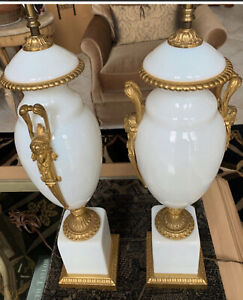
PAIR VINTAGE HOLLYWOOD REGENCY FRENCH OPALINE OPALESCENT GLASS LAMPS GILT BRONZE
PAIR VINTAGE HOLLYWOOD REGENCY FRENCH OPALINE OPALESCENT GLASS LAMPS GILT BRONZEPr Vintage Hollywood Regency French Opaline Opalescent Glass Lamps W Gilt Bronze Ormolu Baccarat StyleFantastic pair of Hollywood Regency 1940-1950 era lamps in a white French opaline opalescent glass with gilt bronze mounts. They are in wonderful vintage condition and the double sockets work perfectlyAn absolutely stunning pair of vintage high quality French Opaline table lamps, with heavy thick white opaline glass and gold gilt (Dore) Ormolu Bronze mounts.The large cast gilt bronze Masks on either sides of each lamp is amazingHeavy lamps both marked Made in France stamped on the bottom inside of the foot.The lamps are heavy and large measuring about 20 to top of Glass (from the bronze base to top of gilt bronze cap) and about 7 " at their widest with the handles.total height is 31" to Finial.This Grecian, Neoclassical lamps are in excellent vintage condition without chips or cracks. The gilded bronze is in perfect condition as well.It will be very well packed and shipped with insurance Thank you for looking and good luck Opaline glass is also a decorative style of glassmade in France from 1800 to the 1890s, though it reached its peak of popularity during the reign of Napoleon III in the 1850s and 1860s. The glass is opaque or slightly translucent, and can appear either white or brightly colored in shades of green, blue, pink, black, lavender and yellow. The glass has a high lead content which defined it as "demi-crystal" or semi-crystal. The primary influences on this style of glass were 16th century Venetian milk glass, and English white glass produced in 18th-century Bristol.Many different pieces were produced in opaline glass, including vases, bowls, cups, coupes, decanters, perfume bottles, boxes, clocks and other implements. The popularity of Opaline glass began during the reign of Napoleon. Cities involved in the production included Le Creusot, Baccarat, and Saint-Louis, Réunion, as well as various locations in England.All opaline glass is hand-blown and has a rough or polished pontil on the bottom. There are no seams and no machine engraving. Many pieces of opaline glass are decorated with gilding. Some with handpainted flowers or birds. Several have bronze ormolu mounts, rims, hinges or holders. Real opaline glass was produced only in France. In the 20th century Italy produced a similar glass and called it opaline veritable.Most opaline glass is not branded or signed.
Sold on eBay July 16th, 2024
HOUSE CARON & BACCARAT Crystal ICONIC Les Fontaines PERFUME FOUNTAIN, Paris
by: BACCARAT & HOUSE OF CARON“Les Fontaines Baccarat" Paris Vintage 1982, Limited Edition Baccarat Perfume Urn EXCLUSIVELY Designed for The HOUSE OF CARON - ParisEXQUISITE CRYSTAL PERFUME FOUNTAINHouse of Caron Perfume Fountain “Les Fontaines Baccarat"100% Genuine CrystalORMOLU PREFUM (Bronze Gilt ) URN /DISPENSARY - Large Fountain Original Signage; for En Avion perfume. Dimensions: 19" tall by 8" wideMarked: Acid Etched Baccarat Logo on the Bottom of Urn. Last sold auction without lid or signage (Karl Langerfield) Southbeys Auction 2015 for for $21,000The Catch is missing a one-inch rope & never had a lid, you can buy purchase both off house of caron or even use other 3rd party retailers who sell custom lids and etc at an affordable price. Also you can obtain more or larger catch from Caron incase you require a larger catch for larger atomizers. MSRP NEW With Perfume: $25,000 * Please view pictures & video closely for details & Condition. Exact item shown is the exact item you will receive Press:From CLEOPATRA'S BOUDOIR Thursday, January 9, 2014In the Caron boutiques, some very precious perfume extracts are housed inside gleaming Baccarat crystal and ormolu urns. The urns are called “Les Fontaines Baccarat Inside the sumptuous urns, are Caron’s haute couture fragrances. Once lost and discontinued, these revived scents are the some of Caron's finest perfume compositions of all time.With the ritualistic act of filling the perfume bottle from the fountain, all of the special heritages of these perfumes live on. The perfumes are collected from the small bronze taps into bottles of all sizes, which are then finished with a antique style golden braid.The urns typically measure 18.5" tall x 7" wide and have an 8" diameter, the square base measures 5" X 5". The base will be acid stamped with the Baccarat logo.In the New York Caron boutique, the 12 Caron fountains, were modeled after the ones in the Caron boutique in Paris. The perfume is sold by volume (7.5 milliliters for $80; 200 for $500). A full urn (which someone did buy in Paris) was for sale for about $10,000 in 2000. By 2009, a fountain containing perfume will set you back at $25,000.The perfume is decanted right in front of you, and even though Caron does not provide a bespoke fragrance making service, Natalie Calmness, Caron's Paris-based creative director, says that it is not unusual for customers to personalize their scent by mixing one or two together. "Both Isabelle Adjani and Madonna come into the boutique and mix their perfumes at the fountains," she says (and Princess Caroline of Monaco is another Caron fan). "It's a way of making your fragrance unique. You can even bring in your own perfume bottle and do it yourself." (Condition: Pre-Owned)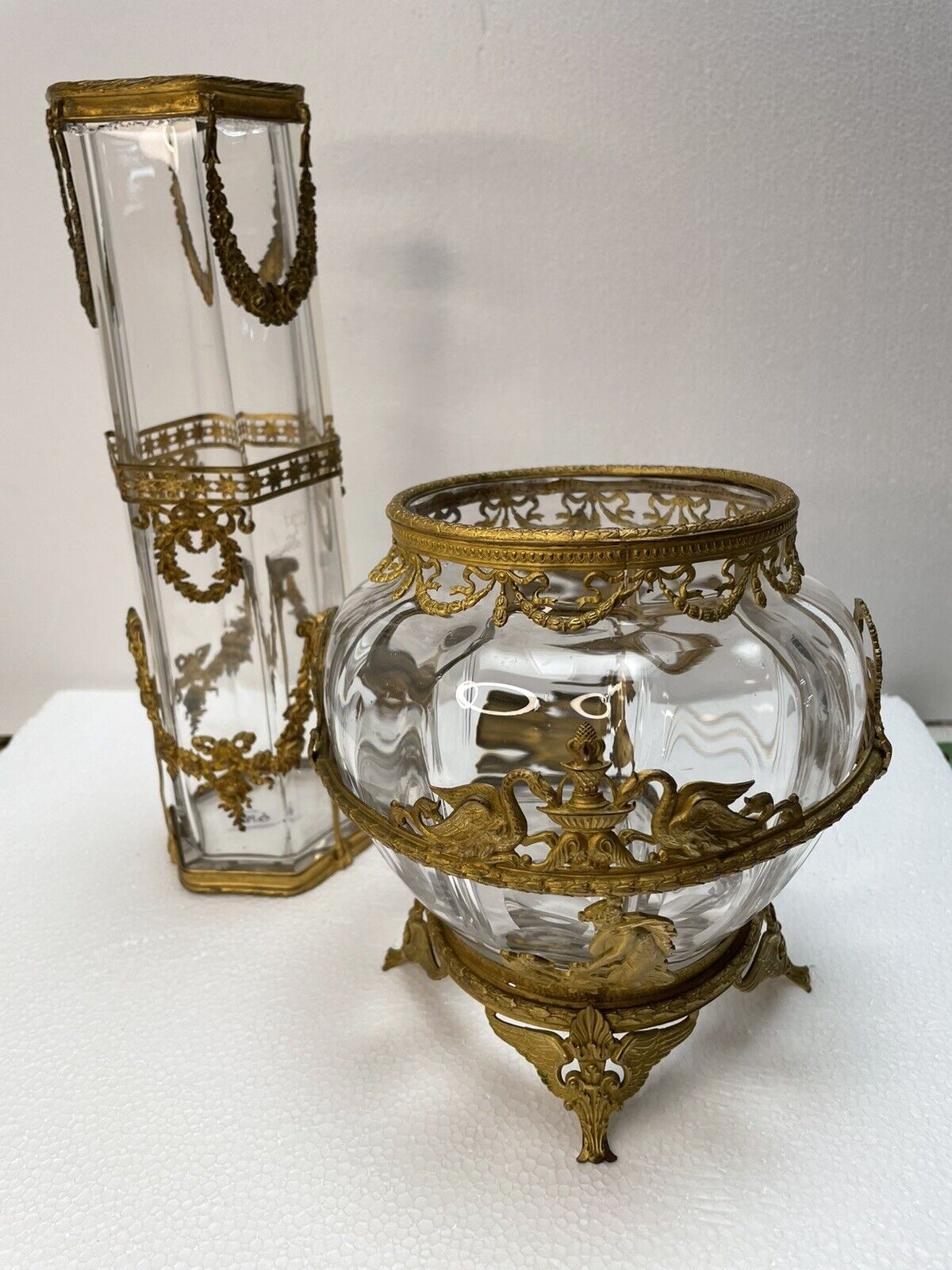
Sold on eBay November 13th, 2024
TWO MAGNIFICENT BACCARAT CRYSTAL AND DORE BRONZE VASES #319
TWO MAGNIFICENT BACCARAT CRYSTAL AND DORE BRONZE VASES BACCARAT WAS KNOWN BEFORE AND AROUND THE TURN OF THE CENTURY FOR THEIR AMAZING CRYSTAL AND DORE BRONZE PIECES. HERE ARE TWO BEING SOLD TOGETHER WITH BEAUTIFUL AND INTRIQUE BRONZE WORK. #1 TALL VASE BACCARAT CRYSTAL IS CLEAN BRONZE WORK GREAT. FROM THE TOP YOU HAVE A DORE BRONZE BAND THAT LEAD TO THREE VERY DETAILED ROSE GARLANDS, MOVING DOWN YOU COME TO A DECORATIVE BAND OF SIMPLE FLOWERS TO A WREATH WITH A BOW THAT IS TIED LIKE A HEARD MOVING DOWN YOU ARRIVE AT A MAGNIFICENT MASK WITH A SUBSTANTIAL BRONZE GARLAND WITH DETAILED AND FLORAL BOUQUETS. IT FINISHES WITH A DORE BRONZE BAND FOR THE CRYSTAL TO SIT IN. #2 ROUND VASE BACCARAT CRYSTAL IS CLEAN BRONZE WORK GREAT.. FROM THE TOP YOU HAVE A CAP OF TASSELS GARLANDS AND RIBBON AMAZING DETAIL MOVING DOWN WINGED ANGELS HOLD UP A BAND THAT RUNS AROUND THE MIDDLE OF THE VASE AND HIGHLIGHTING TWO SWANS DRINKING OUT OF AN ELABORATE FOUNTAIN. THE BOTTOM SHOWS A ROYAL PERSON ACCEPTING A FLAME ON ONE SIDE AND A SHAFT OF WHEAT ON THE OTHER. THE BOTTOM IS ELABORATE WINGED AND SHELL MOTIF ENDING IN A BEAUTIFUL FOOT, SOME OF THE MOST BEAUTIFUL BRONZE WORK I HAVE SEEN. Dimensions: ROUND VASE: HEIGHT: 7 " WIDTH: 7 " TALL VASE: HEIGHT: 11" WIDTH: 3 1/4 "This history of Baccarat spans two hundred years, numerous wars, and unsurpassed advancement in crystal design and manufacturing. Baccarat is a small French town of 600 situated 250 miles east of Paris. In 1764, slightly prior to the French Revolution, Monseigneur de Montmorency Laval the Bishop of Metz, petitioned King Louis XV to allow him to open a glassworks factory on the banks of the River Meurthe. The reason for the Bishop’s interest in opening a glassworks factory was that he owned thousands of acres of old growth forests. In order to turn a profit on the deforestation of his land, the Bishop needed to find some industry that would consume lots of firewood. In 1765, the Compagnie des Cristalleries de Baccarat was established. The Bishop employed the influence of the church to locate an investor to build the factory. His next move was to find an architect and technician to run the factory. A man named Antoine Renaut was hired to oversee the building and running of the Baccarat factory. Baccarat flourished in the coming decades. By the beginnings of the French Revolution, the company employed a work force of 400 people. It must be noted that Baccarat was opened during the age of reason and enlightenment. The managers at Baccarat decided to employee many of the social concepts concerning individual rights and human dignity that arose from the new social philosophies of the period. A small utopian community was built at the Baccarat factory that housed over 70 families. Although Baccarat was ahead of their time in concerning themselves with the welfare of their employees, their motives were not entirely altruistic. The firing of glass at the time was still an imperfect art and was influenced by many factors, including the weather. It was important to have Baccarat’s master craftsmen very close to the factory in order to produce the best possible product. During this time, the company mainly produced bottles, mirrors, and windows panes. Baccarat met a formidable challenge at the beginning of the French Revolution. Economic instability was common in France at this time, however, the situation worsened as the country collapsed into civil war. France’s economic situation continued to worsen with the Napoleonic wars that swept across Europe during the early 19th century. By 1816, inflation caused the company to operate at a loss and the work force was reduced to less than 70 people. During that same year, the factory was sold to a Belgian expert in the production of glass. The purchaser, Monsieur d’Artigues bought the company with 2,845 ounces of solid gold. Monsieur d’Artigues was an ambitious man who set his sites on making Baccarat one of the most prestigious names in glass in Europe and the world. In 1838, a manager at Baccarat discovered a way to produce full-lead crystal that could be colored. The formula was one of the company’s most closely guarded trade secrets. However, the information was leaked to the Bohemians living in the area who produced similar works to those of Baccarat. There was no competition between Baccarat and the Bohemians however, as the Bohemian interest was purely artistic and they philosophically were not interested in making a profit. The factory continued to grow in prestige throughout the remainder of the 19th century. By the end of the 19th century, Baccarat had earned the reputation of being the “Crystal of Kings.” This title is one that the company bears to this day. Baccarat’s stemware and objects d’art adorned the tables of the late Czar and Czarina of Russia, the Emperor of Japan, the late Sultan of Turkey, the King of Siam, Presidents Theodore Roosevelt and Franklin Delano Roosevelt, the last three kings of France – Louis XVIII, Charles X, and Louis Philippe, all the Presidents of the French Republic, the Late Aga Kahn, Pope Benedict XV, President of the Republic of Chile, the former king of Portugal, the late king of Spain, the King of Greece, Emperor Haile Selassie of Ethiopia, the late Wilhelm II of Germany, the US State Departments’ many legations and European Embassies, all of the Maharajahs of India, and King Ibn of Saudia Arabia. For display pieces for the famous Paris Exhibition of 1889 (the same exhibition during which the Eiffel Tower was built), Baccarat created two of its most popular pattern Harcourt and Gascogne. Today, Harcourt is one of the Pope’s stemware patterns at the Vatican. (Condition: Pre-Owned)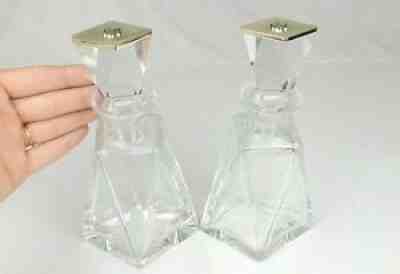
Sold on eBay Jul 28, 2021
Art Deco 14K Solid Yellow Gold Baccarat Crystal Perfume Vanity Bottles Large Set
Very heavy and very well made. The vanity bottles stand 8.25" tall with the stoppers. One hole being 3/4" across and the other being 1" across. Condition: Very Good Condition. Very high quality. The Crystal is very heavy.
Sold on eBay May 23rd, 2024
BACCARAT 12 DESSERT OR SALAD PLATES "PARIS" PATTERN CLEAR #419
BACCARAT DESSERT OR SALAD PLATES PARIS PATTERN CLEAR Antique and truly beautiful set of 12 Baccarat crystal plates. Very contemporary and never used. No a knife mark on them. Would be great with a creative dessert or salad or as them used for hors d'oeuvre Not often do you find a set in this condition. Would be a great gift or something for special evening events.HEIGHT: 1/2 " WIDTH: 6 1/2" BACCARATThis history of Baccarat spans two hundred years, numerous wars, and unsurpassed advancement in crystal design and manufacturing. Baccarat is a small French town of 600 situated 250 miles east of Paris. In 1764, slightly prior to the French Revolution, Monseigneur de Montmorency Laval the Bishop of Metz, petitioned King Louis XV to allow him to open a glassworks factory on the banks of the River Meurthe. The reason for the Bishop’s interest in opening a glassworks factory was that he owned thousands of acres of old growth forests. In order to turn a profit on the deforestation of his land, the Bishop needed to find some industry that would consume lots of firewood. In 1765, the Compagnie des Cristalleries de Baccarat was established. The Bishop employed the influence of the church to locate an investor to build the factory. His next move was to find an architect and technician to run the factory. A man named Antoine Renaut was hired to oversee the building and running of the Baccarat factory. Baccarat flourished in the coming decades. By the beginnings of the French Revolution, the company employed a workforce of 400 people. It must be noted that Baccarat was opened during the age of reason and enlightenment. The managers at Baccarat decided to employee many of the social concepts concerning individual rights and human dignity that arose from the new social philosophies of the period. A small utopian community was built at the Baccarat factory that housed over 70 families. Although Baccarat was ahead of their time in concerning themselves with the welfare of their employees, their motives were not entirely altruistic. The firing of glass at the time was still an imperfect art and was influenced by many factors, including the weather. It was important to have Baccarat’s master craftsmen very close to the factory in order to produce the best possible product. During this time, the company mainly produced bottles, mirrors, and windows panes. Baccarat met a formidable challenge at the beginning of the French Revolution. Economic instability was common in France at this time, however, the situation worsened as the country collapsed into civil war. France’s economic situation continued to worsen with the Napoleonic wars that swept across Europe during the early 19th century. By 1816, inflation caused the company to operate at a loss and the workforce was reduced to less than 70 people. During that same year, the factory was sold to a Belgian expert in the production of glass. The purchaser, Monsieur d’Artigues bought the company with 2,845 ounces of solid gold. Monsieur d’Artigues was an ambitious man who set his sites on making Baccarat one of the most prestigious names in glass in Europe and the world. In 1838, a manager at Baccarat discovered a way to produce full-lead crystal that could be colored. The formula was one of the company’s most closely guarded trade secrets. However, the information was leaked to the Bohemians living in the area who produced similar works to those of Baccarat. There was no competition between Baccarat and the Bohemians, however, as the Bohemian interest was purely artistic and they philosophically were not interested in making a profit. The factory continued to grow in prestige throughout the remainder of the 19th century. By the end of the 19th century, Baccarat had earned the reputation of being the “Crystal of Kings.” This title is one that the company bears to this day. Baccarat’s stemware and objects d’art adorned the tables of the late Czar and Czarina of Russia, the Emperor of Japan, the late Sultan of Turkey, the King of Siam, Presidents Theodore Roosevelt and Franklin Delano Roosevelt, the last three kings of France – Louis XVIII, Charles X, and Louis Philippe, all the Presidents of the French Republic, the Late Aga Kahn, Pope Benedict XV, President of the Republic of Chile, the former king of Portugal, the late king of Spain, the King of Greece, Emperor Haile Selassie of Ethiopia, the late Wilhelm II of Germany, the US State Departments’ many legations and European Embassies, all of the Maharajahs of India, and King Ibn of Saudia Arabia. For display pieces for the famous Paris Exhibition of 1889 (the same exhibition during which the Eiffel Tower was built), Baccarat created two of its most popular pattern Harcourt and Gascogne. Today, Harcourt is one of the Pope’s stemware patterns at the Vatican. (Condition: Pre-Owned)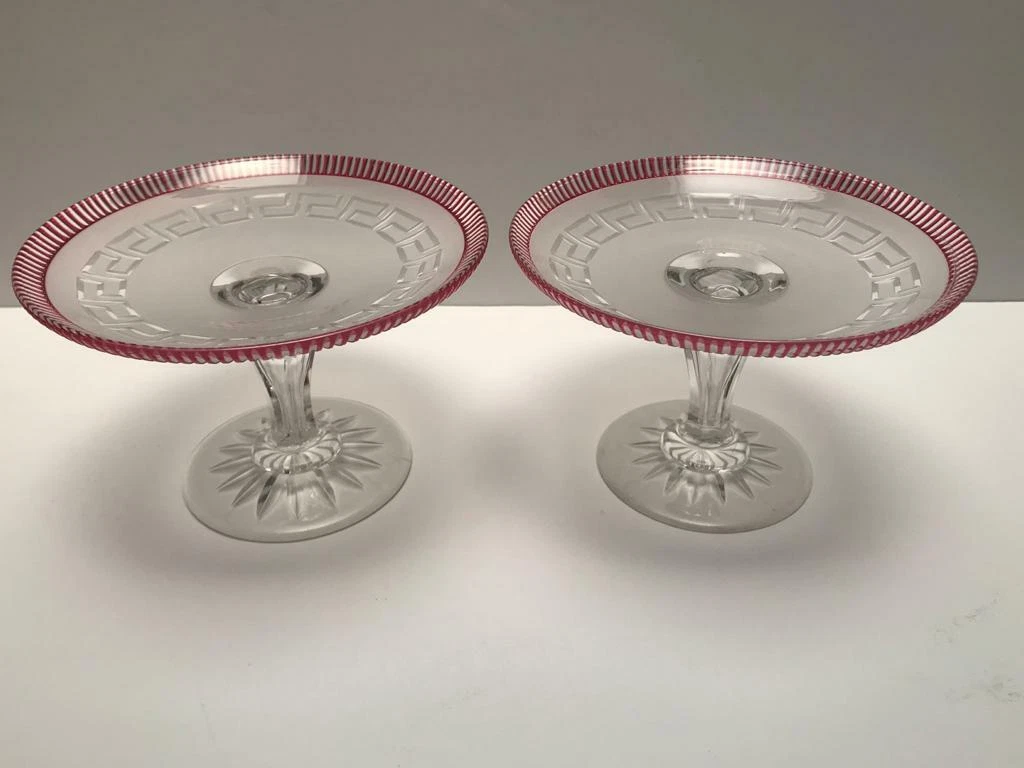
Sold on eBay May 11th, 2025
BACCARAT CRYSTAL RED CUT TO CLEAR TAZZA WITH ACID FROSTED DETAILS RARE
BACCARAT CRYSTAL RED CUT TO CLEAR TAZZA WITH ACID FROSTED DETAILS VERY RAREAntique magnificent and unusual pair of BACCARAT COMPOTIERS. They have a beautiful simple red cut to clear border and surround a acid frosted center with a greek key design into it. The stem is hand blown with a bubble and a acid frosted base with a clear cut star. Made around the turn of the century 1900 and of course not signed. Pieces pre 1940 utilized paper stickers which were removed due to cleaning. The compotier is 5" tall 6 1/2" round. BACCARATThis history of Baccarat spans two hundred years, numerous wars, and unsurpassed advancement in crystal design and manufacturing. Baccarat is a small French town of 600 situated 250 miles east of Paris. In 1764, slightly prior to the French Revolution, Monseigneur de Montmorency-Laval, the Bishop of Metz, petitioned King Louis XV to allow him to open a glassworks factory on the banks of the River Meurthe. The reason for the Bishop's interest in opening a glassworks factory was that he owned thousands of acres of old growth forests. In order to turn a profit on the deforestation of his land, the Bishop needed to find some industry that would consume lots of firewood. In 1765, the Compagnie des Cristalleries de Baccarat was established. The Bishop employed the influence of the church to locate an investor to build the factory. His next move was to find an architect and technician to run the factory. A man named Antoine Renaut was hired to oversee the building and running of the Baccarat factory. Baccarat flourished in the coming decades. By the beginnings of the French Revolution, the company employed a workforce of 400 people. It must be noted that Baccarat was opened during the age of reason and enlightenment. The managers at Baccarat decided to employee many of the social concepts concerning individual rights and human dignity that arose from the new social philosophies of the period. A small utopian community was built at the Baccarat factory that housed over 70 families. Although Baccarat was ahead of their time in concerning themselves with the welfare of their employees, their motives were not entirely altruistic. The firing of glass at the time was still an imperfect art and was influenced by many factors, including the weather. It was important to have Baccarat's master craftsmen very close to the factory in order to produce the best possible product. During this time, the company mainly produced bottles, mirrors, and windows panes. Baccarat met a formidable challenge at the beginning of the French Revolution. Economic instability was common in France at this time, however, the situation worsened as the country collapsed into civil war. France's economic situation continued to worsen with the Napoleonic wars that swept across Europe during the early 19th century. By 1816, inflation caused the company to operate at a loss and the workforce was reduced to less than 70 people. During that same year, the factory was sold to a Belgian expert in the production of glass. The purchaser, Monsieur d'Artigues bought the company with 2,845 ounces of solid gold. Monsieur d'Artigues was an ambitious man who set his sites on making Baccarat one of the most prestigious names in glass in Europe and the world. In 1838, a manager at Baccarat discovered a way to produce full-lead crystal that could be colored. The formula was one of the company's most closely guarded trade secrets. However, the information was leaked to the Bohemians living in the area who produced similar works to those of Baccarat. There was no competition between Baccarat and the Bohemians, however, as the Bohemian interest was purely artistic and they philosophically were not interested in making a profit. The factory continued to grow in prestige throughout the remainder of the 19th century. By the end of the 19th century, Baccarat had earned the reputation of being the "Crystal of Kings." This title is one that the company bears to this day. Baccarat's stemware and objects d'art adorned the tables of the late Czar and Czarina of Russia, the Emperor of Japan, the late Sultan of Turkey, the King of Siam, Presidents Theodore Roosevelt and Franklin Delano Roosevelt, the last three kings of France - Louis XVIII, Charles X, and Louis Philippe, all the Presidents of the French Republic, the Late Aga Kahn, Pope Benedict XV, President of the Republic of Chile, the former king of Portugal, the late king of Spain, the King of Greece, Emperor Haile Selassie of Ethiopia, the late Wilhelm II of Germany, the US State Departments' many legations and European Embassies, all of the Maharajahs of India, and King Ibn of Saudia Arabia. For display pieces for the famous Paris Exhibition of 1889 (the same exhibition during which the Eiffel Tower was built), Baccarat created two of its most popular pattern Harcourt and Gascogne. Today, Harcourt is one of the Pope's stemware patterns at the Vatican. (Condition: Pre-Owned)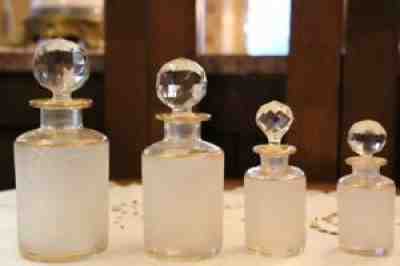
Sold on eBay Jul 12, 2021
Baccarat crystal perfume bottles crystal vanity set baccarat France paris
Crystal set of 4 pieces. Gilt crystal decoration. 4th bottle. 3rd bottle.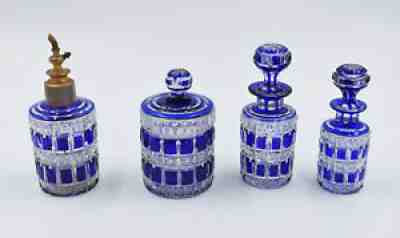
Sold on eBay Sep 05, 2021
4 pieces baccarat vaporizer and bottles crystal double colour blue
HAUTEUR VAPORISATEUR hauteur : 16 cm : partie supperieure en laiton a changer. GRAND FLACON hauteur 14.5 cm en parfait état. VOIR DESCRITION.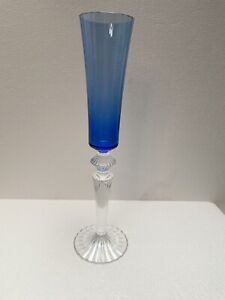
Sold on eBay October 7th, 2023
BACCARAT "MILLE NUITS' AQUA AND CLEAR SET OF 3 GLASSES #394
BACCARAT "MILLE NUITS' AQUA AND CLEAR GLASS SET OF 3 Magnificent set of Baccarat MILLE NUIT champagne glasses in aqua and clear crystal. The base of the glass is heavily cut and sparkles as it goes up the stem to a large jewel that all parts are cut. The bowl is a beautiful shade of aqua and has an optic effect that catches the light. The entire glass on a table shimmers and very elegant. This is a must for those who entertain or possibly an upcoming wedding gift. Dimensions: HEIGHT: 11 1/2 inches Width: 3 history of Baccarat spans two hundred years, numerous wars, and unsurpassed advancement in crystal design and manufacturing. Baccarat is a small French town of 600 situated 250 miles east of Paris. In 1764, slightly prior to the French Revolution, Monseigneur de Montmorency Laval the Bishop of Metz, petitioned King Louis XV to allow him to open a glassworks factory on the banks of the River Meurthe. The reason for the Bishop’s interest in opening a glassworks factory was that he owned thousands of acres of old growth forests. In order to turn a profit on the deforestation of his land, the Bishop needed to find some industry that would consume lots of firewood. In 1765, the Compagnie des Cristalleries de Baccarat was established. The Bishop employed the influence of the church to locate an investor to build the factory. His next move was to find an architect and technician to run the factory. A man named Antoine Renaut was hired to oversee the building and running of the Baccarat factory. Baccarat flourished in the coming decades. By the beginnings of the French Revolution, the company employed a workforce of 400 people. It must be noted that Baccarat was opened during the age of reason and enlightenment. The managers at Baccarat decided to employee many of the social concepts concerning individual rights and human dignity that arose from the new social philosophies of the period. A small utopian community was built at the Baccarat factory that housed over 70 families. Although Baccarat was ahead of their time in concerning themselves with the welfare of their employees, their motives were not entirely altruistic. The firing of glass at the time was still an imperfect art and was influenced by many factors, including the weather. It was important to have Baccarat’s master craftsmen very close to the factory in order to produce the best possible product. During this time, the company mainly produced bottles, mirrors, and windows panes. Baccarat met a formidable challenge at the beginning of the French Revolution. Economic instability was common in France at this time, however, the situation worsened as the country collapsed into civil war. France’s economic situation continued to worsen with the Napoleonic wars that swept across Europe during the early 19th century. By 1816, inflation caused the company to operate at a loss and the workforce was reduced to less than 70 people. During that same year, the factory was sold to a Belgian expert in the production of glass. The purchaser, Monsieur d’Artigues bought the company with 2,845 ounces of solid gold. Monsieur d’Artigues was an ambitious man who set his sites on making Baccarat one of the most prestigious names in glass in Europe and the world. In 1838, a manager at Baccarat discovered a way to produce a full-lead crystal that could be colored. The formula was one of the company’s most closely guarded trade secrets. However, the information was leaked to the Bohemians living in the area who produced similar works to those of Baccarat. There was no competition between Baccarat and the Bohemians, however, as the Bohemian interest was purely artistic and they philosophically were not interested in making a profit. The factory continued to grow in prestige throughout the remainder of the 19th century. By the end of the 19th century, Baccarat had earned the reputation of being the “Crystal of Kings.” This title is one that the company bears to this day. Baccarat’s stemware and objects d’art adorned the tables of the late Czar and Czarina of Russia, the Emperor of Japan, the late Sultan of Turkey, the King of Siam, Presidents Theodore Roosevelt and Franklin Delano Roosevelt, the last three kings of France – Louis XVIII, Charles X, and Louis Philippe, all the Presidents of the French Republic, the Late Aga Kahn, Pope Benedict XV, President of the Republic of Chile, the former king of Portugal, the late king of Spain, the King of Greece, Emperor Haile Selassie of Ethiopia, the late Wilhelm II of Germany, the US State Departments’ many legations and European Embassies, all of the Maharajahs of India, and King Ibn of Saudia Arabia. For display pieces for the famous Paris Exhibition of 1889 (the same exhibition during which the Eiffel Tower was built), Baccarat created two of its most popular pattern Harcourt and Gascogne. Today, Harcourt is one of the Pope’s stemware patterns at the Vatican. (Condition: Pre-Owned)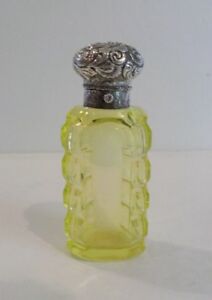
Sold on eBay April 1st, 2024
19th C. Baccarat VASELINE Glass Perfume / Scent Bottle, Embossed Silver Top
Welcome to Antiques & Moore! This listing is for a pretty antique Baccarat crystal perfume/scent bottle in Vaseline glass, c. 1880. The Vaseline color was achieved by adding uranium into the glass batch which gives the glass a yellow-green glow when placed under a black light. The bottle has a concave panel down the front and back with the sides cut in three vertical block panels. The bottle has an embossed silver unmarked top that is guaranteed to be a minimum of .800 silver and is possibly Sterling Silver. Silver has not been tested and .800 silver was commonly used during this period in Europe. The cap is engraved with an all-over design and opens with flip top. The hinge is tight and the bottle opens and closes correctly. Tiny interior glass stopper is missing. Measures 3 1/2" high, 1 3/8" wide and 1" deep. Weighs 2.7 ounces. This nice perfume bottle is in excellent Estate condition with no flaws to the silver or glass body and reflects only minor signs of normal wear. Internal glass stopper is missing. We currently have a large assortment of perfume and scent bottles available so please check our eBay Store for our other great items. We are always happy to combine packing to save on shipping charges.We welcome International buyers, however, please be aware that we as sellers can not be responsible for any random Customs inspections or charges incurred with this purchase. We at Antiques & Moore have been in the Antiques business for over 30 years and try to describe our items as accurately as possible. Although all sales are considered final, if there is an error in our description or a problem with our item, we will issue a full refund of the purchase price if contacted within 3 days after receipt of the item, however, please note that we cannot refund shipping charges. We are happy to answer any questions and always appreciate your business!Btc only for paymentBTC Address: you,orla weir5 gelvin Londonderry bt472dqUnited KingdomPlease confirm your payment prior buyitnowE-mail orlaith.weir gmail.comPhone +44 7745 520135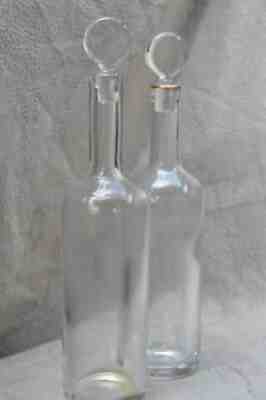
Sold on eBay Jul 04, 2021
Baccarat Liquor Decanters (2)
Paair of Baccarat liquor bottles, one slightly taller than the other makes them very appealing.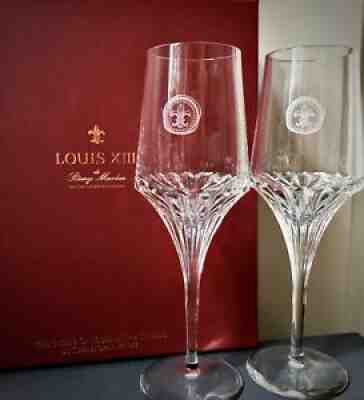
Sold on eBay Jun 09, 2021
Remy Martin - Louis XIII - 2 Exclusive Cognac Glasses by Baccarat
Thay are hand manufactured (like the Louis XIII decanters bottles) by Baccarat and Saint Louis - the two most prestigious French manufacturers of traditionally handmade crystal. A set of 2, new and unused Louis XIII Cognac glass from my huge personal collection that is being reorganised.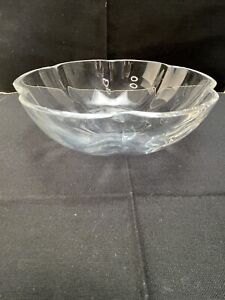
Sold on eBay August 25th, 2023
BACCARAT LARGE "CORAIL" SERVING BOWLS. CONTEMPORARY CRYSTAL #425
BACCARAT LARGE "CORAIL" SERVING BOWLS. CONTEMPORARY CRYSTALGREAT SIZE AND MULTI PURPOSE. CAN BE USED TO SERVE PART OF YOUR DINNER IN, CAN BE FOR A HOMEMADE DESSERT THIS SIZE IS IDEAL FOR 4-6 THERE ARE 3 BOWLS HOWEVER YOU ARE ONLY BE CHARGED FOR 2. ONE OF THE BOWLS HAS MANY SHELF SCRATCHES SO IT IS BEING OFFERED AS FREE. THERE ARE 3 LISTINGS FOR THESE BOWLS AND WOULD WORK VERY GOOD FOR SOMEONE WHO DOES ALOT OF ENTERTAINING WHEN THESE WERE OFFERED IN 1960 THE PRICE PRICE WAS 300 DOLLARS. THINK OF WHAT YOU MIGHT USE THESE FOR. HEIGHT: 3" WIDTH: 7 3/4" BACCARATThis history of Baccarat spans two hundred years, numerous wars, and unsurpassed advancement in crystal design and manufacturing. Baccarat is a small French town of 600 situated 250 miles east of Paris. In 1764, slightly prior to the French Revolution, Monseigneur de Montmorency Laval the Bishop of Metz, petitioned King Louis XV to allow him to open a glassworks factory on the banks of the River Meurthe. The reason for the Bishop’s interest in opening a glassworks factory was that he owned thousands of acres of old growth forests. In order to turn a profit on the deforestation of his land, the Bishop needed to find some industry that would consume lots of firewood. In 1765, the Compagnie des Cristalleries de Baccarat was established. The Bishop employed the influence of the church to locate an investor to build the factory. His next move was to find an architect and technician to run the factory. A man named Antoine Renaut was hired to oversee the building and running of the Baccarat factory. Baccarat flourished in the coming decades. By the beginnings of the French Revolution, the company employed a workforce of 400 people. It must be noted that Baccarat was opened during the age of reason and enlightenment. The managers at Baccarat decided to employee many of the social concepts concerning individual rights and human dignity that arose from the new social philosophies of the period. A small utopian community was built at the Baccarat factory that housed over 70 families. Although Baccarat was ahead of their time in concerning themselves with the welfare of their employees, their motives were not entirely altruistic. The firing of glass at the time was still an imperfect art and was influenced by many factors, including the weather. It was important to have Baccarat’s master craftsmen very close to the factory in order to produce the best possible product. During this time, the company mainly produced bottles, mirrors, and windows panes. Baccarat met a formidable challenge at the beginning of the French Revolution. Economic instability was common in France at this time, however, the situation worsened as the country collapsed into civil war. France’s economic situation continued to worsen with the Napoleonic wars that swept across Europe during the early 19th century. By 1816, inflation caused the company to operate at a loss and the workforce was reduced to less than 70 people. During that same year, the factory was sold to a Belgian expert in the production of glass. The purchaser, Monsieur d’Artigues bought the company with 2,845 ounces of solid gold. Monsieur d’Artigues was an ambitious man who set his sites on making Baccarat one of the most prestigious names in glass in Europe and the world. In 1838, a manager at Baccarat discovered a way to produce full-lead crystal that could be colored. The formula was one of the company’s most closely guarded trade secrets. However, the information was leaked to the Bohemians living in the area who produced similar works to those of Baccarat. There was no competition between Baccarat and the Bohemians, however, as the Bohemian interest was purely artistic and they philosophically were not interested in making a profit. The factory continued to grow in prestige throughout the remainder of the 19th century. By the end of the 19th century, Baccarat had earned the reputation of being the “Crystal of Kings.” This title is one that the company bears to this day. Baccarat’s stemware and objects d’art adorned the tables of the late Czar and Czarina of Russia, the Emperor of Japan, the late Sultan of Turkey, the King of Siam, Presidents Theodore Roosevelt and Franklin Delano Roosevelt, the last three kings of France – Louis XVIII, Charles X, and Louis Philippe, all the Presidents of the French Republic, the Late Aga Kahn, Pope Benedict XV, President of the Republic of Chile, the former king of Portugal, the late king of Spain, the King of Greece, Emperor Haile Selassie of Ethiopia, the late Wilhelm II of Germany, the US State Departments’ many legations and European Embassies, all of the Maharajahs of India, and King Ibn of Saudia Arabia. For display pieces for the famous Paris Exhibition of 1889 (the same exhibition during which the Eiffel Tower was built), Baccarat created two of its most popular pattern Harcourt and Gascogne. Today, Harcourt is one of the Pope’s stemware patterns at the Vatican. (Condition: Pre-Owned)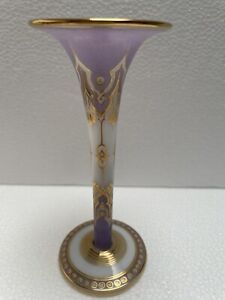
Sold on eBay July 28th, 2023
MAGNIFICENT BACCARAT OPALINE SOLIFLORE VASE #363
MAGNIFICENT BACCARAT OPALINE SOLIFLORE VASE Mint condition Antique ornate Baccarat vase with an Art Nouveau design. Beautifully hand painted with all the flare of the art nouveau period. Its main background is a pale lavender the detail and gracefulness of the painting and all embellished with gold details. This piece demonstrates the excellent workmanship only associated with the top French crystalleries. This would make a great gift or something to add to a collectors display or in a display cabinet Dimensions: DIAMETER: 2 1/2 INCHES / HEIGHT: 6 INCHESBACCARATThis history of Baccarat spans two hundred years, numerous wars, and unsurpassed advancement in crystal design and manufacturing. Baccarat is a small French town of 600 situated 250 miles east of Paris. In 1764, slightly prior to the French Revolution, Monseigneur de Montmorency Laval the Bishop of Metz, petitioned King Louis XV to allow him to open a glassworks factory on the banks of the River Meurthe. The reason for the Bishop’s interest in opening a glassworks factory was that he owned thousands of acres of old growth forests. In order to turn a profit on the deforestation of his land, the Bishop needed to find some industry that would consume lots of firewood. In 1765, the Compagnie des Cristalleries de Baccarat was established. The Bishop employed the influence of the church to locate investor to build the factory. His next move was to find an architect and technician to run the factory. A man named Antoine Renaut was hired to oversee the building and running of the Baccarat factory. Baccarat flourished in the coming decades. By the beginnings of the French Revolution, the company employed a work force of 400 people. It must be noted that Baccarat was opened during the age of reason and enlightenment. The managers at Baccarat decided to employee many of the social concepts concerning individual rights and human dignity that arose from the new social philosophies of the period. A small utopian community was built at the Baccarat factory that housed over 70 families. Although Baccarat was ahead of their time in concerning themselves with the welfare of their employees, their motives were not entirely altruistic. The firing of glass at the time was still an imperfect art and was influenced by many factors, including the weather. It was important to have Baccarat’s master craftsmen very close to the factory in order to produce the best possible product. During this time, the company mainly produced bottles, mirrors, and windows panes. Baccarat met a formidable challenge at the beginning of the French Revolution. Economic instability was common in France at this time, however, the situation worsened as the country collapsed into civil war. France’s economic situation continued to worsen with the Napoleonic wars that swept across Europe during the early 19th century. By 1816, inflation caused the company to operate at a loss and the work force was reduced to less than 70 people. During that same year, the factory was sold to a Belgian expert in the production of glass. The purchaser, Monsieur d’Artigues bought the company with 2,845 ounces of solid gold. Monsieur d’Artigues was an ambitious man who set his sites on making Baccarat one of the most prestigious names in glass in Europe and the world. In 1838, a manager at Baccarat discovered a way to produce full-lead crystal that could be colored. The formula was one of the company’s most closely guarded trade secrets. However, the information was leaked to the Bohemians living in the area who produced similar works to those of Baccarat. There was no competition between Baccarat and the Bohemians however, as the Bohemian interest was purely artistic and they philosophically were not interested in making a profit. The factory continued to grow in prestige throughout the remainder of the 19th century. By the end of the 19th century, Baccarat had earned the reputation of being the “Crystal of Kings.” This title is one that the company bears to this day. Baccarat’s stemware and objects d’art adorned the tables of the late Czar and Czarina of Russia, the Emperor of Japan, the late Sultan of Turkey, the King of Siam, Presidents Theodore Roosevelt and Franklin Delano Roosevelt, the last three kings of France – Louis XVIII, Charles X, and Louis Philippe, all the Presidents of the French Republic, the Late Aga Kahn, Pope Benedict XV, President of the Republic of Chile, the former king of Portugal, the late king of Spain, the King of Greece, Emperor Haile Selassie of Ethiopia, the late Wilhelm II of Germany, the US State Departments’ many legations and European Embassies, all of the Maharajahs of India, and King Ibn of Saudia Arabia. For display pieces for the famous Paris Exhibition of 1889 (the same exhibition during which the Eiffel Tower was built), Baccarat created two of its most popular pattern Harcourt and Gascogne. Today, Harcourt is one of the Pope’s stemware patterns at the Vatican. (Condition: Pre-Owned)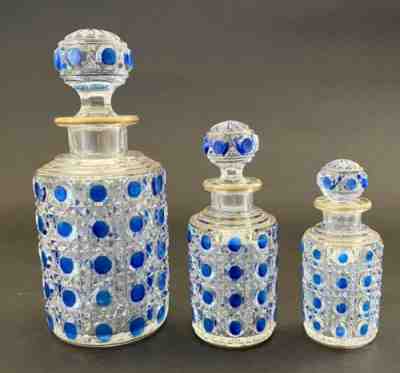
Sold on eBay Feb 14, 2023
Collection of 3 Antique Baccarat "Diamant Pierreries Bleu" Model Perfume Bottles
Find many great new & used options and get the best deals for Collection of 3 Antique Baccarat "Diamant Pierreries Bleu" Model Perfume Bottles at the best online prices at eBay! Free shipping for many products!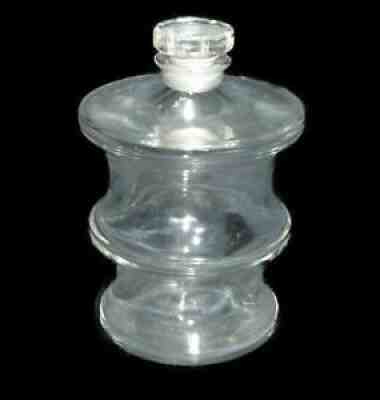
Sold on eBay Jan 12, 2022
Antique RARE Tiered Guerlain Signed Baccarat Crystal Perfume Bottle
Superb!! Rare, French Art Deco Tiered signed Baccarat clear glass*Guerlain* perfume bottle,with beautiful glass stopper. Both the bottom of the bottle and the stopper are marked with the # 92. This is indeed a very unusual piece seldom see. Very impressive!! piece that will make a collector very happy!!!. ***Please check our other items we are listing some very unusual and rare perfume bottles from a 55 years old private collection*** ***We Ship internationally Please contact us for a Quote to your location . Import duties, taxes and charges are not included in the item price or shipping charg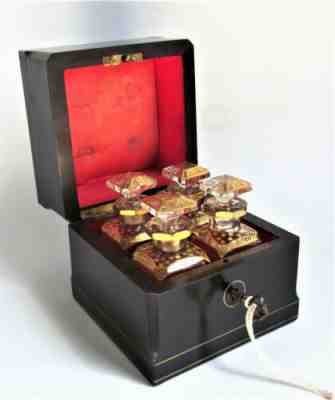
Sold on eBay Jul 29, 2022
Antique BACCARAT French PERFUME CASKET Gilt Glass BOTTLE CADDY Box Case France
FOUR (4) FITTED BACCARAT BOTTLE TRAVEL CASKET DRESSER LOCK BOX with KEY. casket and bottles are beautifully proportioned and perfectly balanced. canted sides, blind brass hinges, fine inlay lock closure.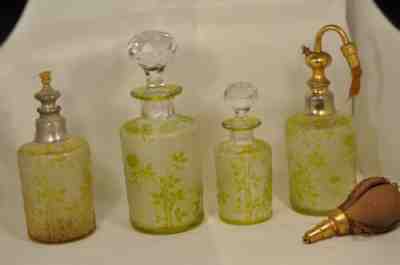
Sold on eBay Feb 20, 2023
4 ANTIQUE EGLANTINE BACCARAT TOILET BOTTLES
Find many great new & used options and get the best deals for 4 ANTIQUE EGLANTINE BACCARAT TOILET BOTTLES at the best online prices at eBay! Free shipping for many products!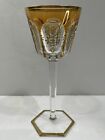
Sold on eBay May 21st, 2024
MAGNIFICENT SET OF BACCARAT " HARCOURT GOLD " WINE SOLD INDIVIDUALLY #534
BACCARAT GLASSES "HARCOURT GOLD" 7 AVAILABLE COLORED CUT TO CLEAR SOLD INDIVIDUALLY #534 Magnificent set of Baccarat colored cut to clear Harcourt Gold wine goblets The intricate scallop cutting on the glasses side leaving a vignette to place the 24k filagree pattern the cup leads to a 6 sided stem and base the base highlighted like the glass top with a band of cold. This is not a common pattern especially in color and these are perfect. (2) Amethyst (1) Emerald (1) Cobalt (1) Lime (1) Orange (1) Fuschia I have never had them in this tall model in color in 50 years of french luxury goods. Dimensions: HEIGHT: 7 1/2 inches Width: 3" history of Baccarat spans two hundred years, numerous wars, and unsurpassed advancement in crystal design and manufacturing. Baccarat is a small French town of 600 situated 250 miles east of Paris. In 1764, slightly prior to the French Revolution, Monseigneur de Montmorency Laval the Bishop of Metz, petitioned King Louis XV to allow him to open a glassworks factory on the banks of the River Meurthe. The reason for the Bishop’s interest in opening a glassworks factory was that he owned thousands of acres of old growth forests. In order to turn a profit on the deforestation of his land, the Bishop needed to find some industry that would consume lots of firewood. In 1765, the Compagnie des Cristalleries de Baccarat was established. The Bishop employed the influence of the church to locate an investor to build the factory. His next move was to find an architect and technician to run the factory. A man named Antoine Renaut was hired to oversee the building and running of the Baccarat factory. Baccarat flourished in the coming decades. By the beginnings of the French Revolution, the company employed a workforce of 400 people. It must be noted that Baccarat was opened during the age of reason and enlightenment. The managers at Baccarat decided to employee many of the social concepts concerning individual rights and human dignity that arose from the new social philosophies of the period. A small utopian community was built at the Baccarat factory that housed over 70 families. Although Baccarat was ahead of their time in concerning themselves with the welfare of their employees, their motives were not entirely altruistic. The firing of glass at the time was still an imperfect art and was influenced by many factors, including the weather. It was important to have Baccarat’s master craftsmen very close to the factory in order to produce the best possible product. During this time, the company mainly produced bottles, mirrors, and windows panes. Baccarat met a formidable challenge at the beginning of the French Revolution. Economic instability was common in France at this time, however, the situation worsened as the country collapsed into civil war. France’s economic situation continued to worsen with the Napoleonic wars that swept across Europe during the early 19th century. By 1816, inflation caused the company to operate at a loss and the workforce was reduced to less than 70 people. During that same year, the factory was sold to a Belgian expert in the production of glass. The purchaser, Monsieur d’Artigues bought the company with 2,845 ounces of solid gold. Monsieur d’Artigues was an ambitious man who set his sites on making Baccarat one of the most prestigious names in glass in Europe and the world. In 1838, a manager at Baccarat discovered a way to produce a full-lead crystal that could be colored. The formula was one of the company’s most closely guarded trade secrets. However, the information was leaked to the Bohemians living in the area who produced similar works to those of Baccarat. There was no competition between Baccarat and the Bohemians, however, as the Bohemian interest was purely artistic and they philosophically were not interested in making a profit. The factory continued to grow in prestige throughout the remainder of the 19th century. By the end of the 19th century, Baccarat had earned the reputation of being the “Crystal of Kings.” This title is one that the company bears to this day. Baccarat’s stemware and objects d’art adorned the tables of the late Czar and Czarina of Russia, the Emperor of Japan, the late Sultan of Turkey, the King of Siam, Presidents Theodore Roosevelt and Franklin Delano Roosevelt, the last three kings of France – Louis XVIII, Charles X, and Louis Philippe, all the Presidents of the French Republic, the Late Aga Kahn, Pope Benedict XV, President of the Republic of Chile, the former king of Portugal, the late king of Spain, the King of Greece, Emperor Haile Selassie of Ethiopia, the late Wilhelm II of Germany, the US State Departments’ many legations and European Embassies, all of the Maharajahs of India, and King Ibn of Saudia Arabia. For display pieces for the famous Paris Exhibition of 1889 (the same exhibition during which the Eiffel Tower was built), Baccarat created two of its most popular pattern Harcourt and Gascogne. Today, Harcourt is one of the Pope’s stemware patterns at the Vatican. (Condition: Brand New)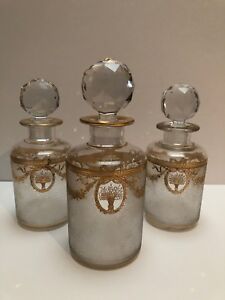
Sold on eBay January 15th, 2024