

Baccarat Collectibles : Baccarat+pope Price List
average value
-
low
-high
-Found 20 out of 35,154 items matching 'pope'
Sold on eBay November 13th, 2024
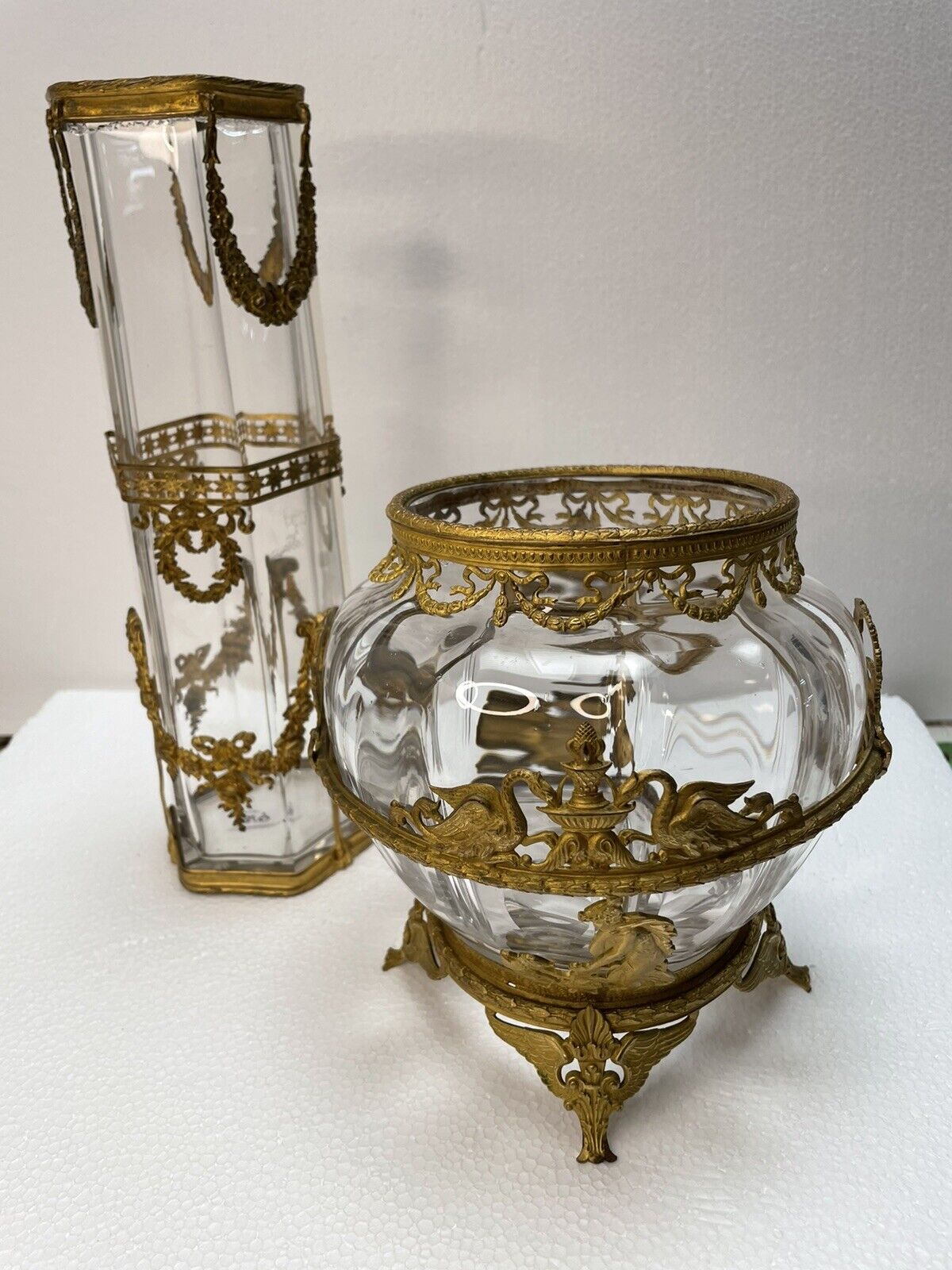
TWO MAGNIFICENT BACCARAT CRYSTAL AND DORE BRONZE VASES #319
TWO MAGNIFICENT BACCARAT CRYSTAL AND DORE BRONZE VASES BACCARAT WAS KNOWN BEFORE AND AROUND THE TURN OF THE CENTURY FOR THEIR AMAZING CRYSTAL AND DORE BRONZE PIECES. HERE ARE TWO BEING SOLD TOGETHER WITH BEAUTIFUL AND INTRIQUE BRONZE WORK. #1 TALL VASE BACCARAT CRYSTAL IS CLEAN BRONZE WORK GREAT. FROM THE TOP YOU HAVE A DORE BRONZE BAND THAT LEAD TO THREE VERY DETAILED ROSE GARLANDS, MOVING DOWN YOU COME TO A DECORATIVE BAND OF SIMPLE FLOWERS TO A WREATH WITH A BOW THAT IS TIED LIKE A HEARD MOVING DOWN YOU ARRIVE AT A MAGNIFICENT MASK WITH A SUBSTANTIAL BRONZE GARLAND WITH DETAILED AND FLORAL BOUQUETS. IT FINISHES WITH A DORE BRONZE BAND FOR THE CRYSTAL TO SIT IN. #2 ROUND VASE BACCARAT CRYSTAL IS CLEAN BRONZE WORK GREAT.. FROM THE TOP YOU HAVE A CAP OF TASSELS GARLANDS AND RIBBON AMAZING DETAIL MOVING DOWN WINGED ANGELS HOLD UP A BAND THAT RUNS AROUND THE MIDDLE OF THE VASE AND HIGHLIGHTING TWO SWANS DRINKING OUT OF AN ELABORATE FOUNTAIN. THE BOTTOM SHOWS A ROYAL PERSON ACCEPTING A FLAME ON ONE SIDE AND A SHAFT OF WHEAT ON THE OTHER. THE BOTTOM IS ELABORATE WINGED AND SHELL MOTIF ENDING IN A BEAUTIFUL FOOT, SOME OF THE MOST BEAUTIFUL BRONZE WORK I HAVE SEEN. Dimensions: ROUND VASE: HEIGHT: 7 " WIDTH: 7 " TALL VASE: HEIGHT: 11" WIDTH: 3 1/4 "This history of Baccarat spans two hundred years, numerous wars, and unsurpassed advancement in crystal design and manufacturing. Baccarat is a small French town of 600 situated 250 miles east of Paris. In 1764, slightly prior to the French Revolution, Monseigneur de Montmorency Laval the Bishop of Metz, petitioned King Louis XV to allow him to open a glassworks factory on the banks of the River Meurthe. The reason for the Bishop’s interest in opening a glassworks factory was that he owned thousands of acres of old growth forests. In order to turn a profit on the deforestation of his land, the Bishop needed to find some industry that would consume lots of firewood. In 1765, the Compagnie des Cristalleries de Baccarat was established. The Bishop employed the influence of the church to locate an investor to build the factory. His next move was to find an architect and technician to run the factory. A man named Antoine Renaut was hired to oversee the building and running of the Baccarat factory. Baccarat flourished in the coming decades. By the beginnings of the French Revolution, the company employed a work force of 400 people. It must be noted that Baccarat was opened during the age of reason and enlightenment. The managers at Baccarat decided to employee many of the social concepts concerning individual rights and human dignity that arose from the new social philosophies of the period. A small utopian community was built at the Baccarat factory that housed over 70 families. Although Baccarat was ahead of their time in concerning themselves with the welfare of their employees, their motives were not entirely altruistic. The firing of glass at the time was still an imperfect art and was influenced by many factors, including the weather. It was important to have Baccarat’s master craftsmen very close to the factory in order to produce the best possible product. During this time, the company mainly produced bottles, mirrors, and windows panes. Baccarat met a formidable challenge at the beginning of the French Revolution. Economic instability was common in France at this time, however, the situation worsened as the country collapsed into civil war. France’s economic situation continued to worsen with the Napoleonic wars that swept across Europe during the early 19th century. By 1816, inflation caused the company to operate at a loss and the work force was reduced to less than 70 people. During that same year, the factory was sold to a Belgian expert in the production of glass. The purchaser, Monsieur d’Artigues bought the company with 2,845 ounces of solid gold. Monsieur d’Artigues was an ambitious man who set his sites on making Baccarat one of the most prestigious names in glass in Europe and the world. In 1838, a manager at Baccarat discovered a way to produce full-lead crystal that could be colored. The formula was one of the company’s most closely guarded trade secrets. However, the information was leaked to the Bohemians living in the area who produced similar works to those of Baccarat. There was no competition between Baccarat and the Bohemians however, as the Bohemian interest was purely artistic and they philosophically were not interested in making a profit. The factory continued to grow in prestige throughout the remainder of the 19th century. By the end of the 19th century, Baccarat had earned the reputation of being the “Crystal of Kings.” This title is one that the company bears to this day. Baccarat’s stemware and objects d’art adorned the tables of the late Czar and Czarina of Russia, the Emperor of Japan, the late Sultan of Turkey, the King of Siam, Presidents Theodore Roosevelt and Franklin Delano Roosevelt, the last three kings of France – Louis XVIII, Charles X, and Louis Philippe, all the Presidents of the French Republic, the Late Aga Kahn, Pope Benedict XV, President of the Republic of Chile, the former king of Portugal, the late king of Spain, the King of Greece, Emperor Haile Selassie of Ethiopia, the late Wilhelm II of Germany, the US State Departments’ many legations and European Embassies, all of the Maharajahs of India, and King Ibn of Saudia Arabia. For display pieces for the famous Paris Exhibition of 1889 (the same exhibition during which the Eiffel Tower was built), Baccarat created two of its most popular pattern Harcourt and Gascogne. Today, Harcourt is one of the Pope’s stemware patterns at the Vatican. (Condition: Pre-Owned)
Sold on eBay May 23rd, 2024
BACCARAT 12 DESSERT OR SALAD PLATES "PARIS" PATTERN CLEAR #419
BACCARAT DESSERT OR SALAD PLATES PARIS PATTERN CLEAR Antique and truly beautiful set of 12 Baccarat crystal plates. Very contemporary and never used. No a knife mark on them. Would be great with a creative dessert or salad or as them used for hors d'oeuvre Not often do you find a set in this condition. Would be a great gift or something for special evening events.HEIGHT: 1/2 " WIDTH: 6 1/2" BACCARATThis history of Baccarat spans two hundred years, numerous wars, and unsurpassed advancement in crystal design and manufacturing. Baccarat is a small French town of 600 situated 250 miles east of Paris. In 1764, slightly prior to the French Revolution, Monseigneur de Montmorency Laval the Bishop of Metz, petitioned King Louis XV to allow him to open a glassworks factory on the banks of the River Meurthe. The reason for the Bishop’s interest in opening a glassworks factory was that he owned thousands of acres of old growth forests. In order to turn a profit on the deforestation of his land, the Bishop needed to find some industry that would consume lots of firewood. In 1765, the Compagnie des Cristalleries de Baccarat was established. The Bishop employed the influence of the church to locate an investor to build the factory. His next move was to find an architect and technician to run the factory. A man named Antoine Renaut was hired to oversee the building and running of the Baccarat factory. Baccarat flourished in the coming decades. By the beginnings of the French Revolution, the company employed a workforce of 400 people. It must be noted that Baccarat was opened during the age of reason and enlightenment. The managers at Baccarat decided to employee many of the social concepts concerning individual rights and human dignity that arose from the new social philosophies of the period. A small utopian community was built at the Baccarat factory that housed over 70 families. Although Baccarat was ahead of their time in concerning themselves with the welfare of their employees, their motives were not entirely altruistic. The firing of glass at the time was still an imperfect art and was influenced by many factors, including the weather. It was important to have Baccarat’s master craftsmen very close to the factory in order to produce the best possible product. During this time, the company mainly produced bottles, mirrors, and windows panes. Baccarat met a formidable challenge at the beginning of the French Revolution. Economic instability was common in France at this time, however, the situation worsened as the country collapsed into civil war. France’s economic situation continued to worsen with the Napoleonic wars that swept across Europe during the early 19th century. By 1816, inflation caused the company to operate at a loss and the workforce was reduced to less than 70 people. During that same year, the factory was sold to a Belgian expert in the production of glass. The purchaser, Monsieur d’Artigues bought the company with 2,845 ounces of solid gold. Monsieur d’Artigues was an ambitious man who set his sites on making Baccarat one of the most prestigious names in glass in Europe and the world. In 1838, a manager at Baccarat discovered a way to produce full-lead crystal that could be colored. The formula was one of the company’s most closely guarded trade secrets. However, the information was leaked to the Bohemians living in the area who produced similar works to those of Baccarat. There was no competition between Baccarat and the Bohemians, however, as the Bohemian interest was purely artistic and they philosophically were not interested in making a profit. The factory continued to grow in prestige throughout the remainder of the 19th century. By the end of the 19th century, Baccarat had earned the reputation of being the “Crystal of Kings.” This title is one that the company bears to this day. Baccarat’s stemware and objects d’art adorned the tables of the late Czar and Czarina of Russia, the Emperor of Japan, the late Sultan of Turkey, the King of Siam, Presidents Theodore Roosevelt and Franklin Delano Roosevelt, the last three kings of France – Louis XVIII, Charles X, and Louis Philippe, all the Presidents of the French Republic, the Late Aga Kahn, Pope Benedict XV, President of the Republic of Chile, the former king of Portugal, the late king of Spain, the King of Greece, Emperor Haile Selassie of Ethiopia, the late Wilhelm II of Germany, the US State Departments’ many legations and European Embassies, all of the Maharajahs of India, and King Ibn of Saudia Arabia. For display pieces for the famous Paris Exhibition of 1889 (the same exhibition during which the Eiffel Tower was built), Baccarat created two of its most popular pattern Harcourt and Gascogne. Today, Harcourt is one of the Pope’s stemware patterns at the Vatican. (Condition: Pre-Owned)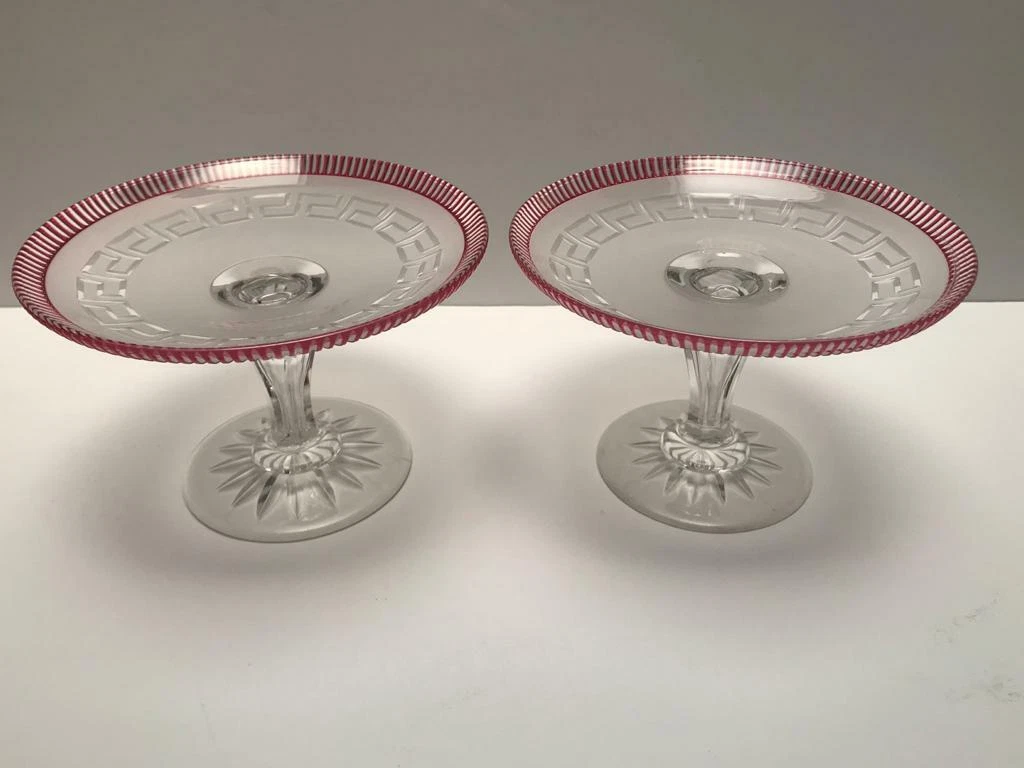
Sold on eBay May 11th, 2025
BACCARAT CRYSTAL RED CUT TO CLEAR TAZZA WITH ACID FROSTED DETAILS RARE
BACCARAT CRYSTAL RED CUT TO CLEAR TAZZA WITH ACID FROSTED DETAILS VERY RAREAntique magnificent and unusual pair of BACCARAT COMPOTIERS. They have a beautiful simple red cut to clear border and surround a acid frosted center with a greek key design into it. The stem is hand blown with a bubble and a acid frosted base with a clear cut star. Made around the turn of the century 1900 and of course not signed. Pieces pre 1940 utilized paper stickers which were removed due to cleaning. The compotier is 5" tall 6 1/2" round. BACCARATThis history of Baccarat spans two hundred years, numerous wars, and unsurpassed advancement in crystal design and manufacturing. Baccarat is a small French town of 600 situated 250 miles east of Paris. In 1764, slightly prior to the French Revolution, Monseigneur de Montmorency-Laval, the Bishop of Metz, petitioned King Louis XV to allow him to open a glassworks factory on the banks of the River Meurthe. The reason for the Bishop's interest in opening a glassworks factory was that he owned thousands of acres of old growth forests. In order to turn a profit on the deforestation of his land, the Bishop needed to find some industry that would consume lots of firewood. In 1765, the Compagnie des Cristalleries de Baccarat was established. The Bishop employed the influence of the church to locate an investor to build the factory. His next move was to find an architect and technician to run the factory. A man named Antoine Renaut was hired to oversee the building and running of the Baccarat factory. Baccarat flourished in the coming decades. By the beginnings of the French Revolution, the company employed a workforce of 400 people. It must be noted that Baccarat was opened during the age of reason and enlightenment. The managers at Baccarat decided to employee many of the social concepts concerning individual rights and human dignity that arose from the new social philosophies of the period. A small utopian community was built at the Baccarat factory that housed over 70 families. Although Baccarat was ahead of their time in concerning themselves with the welfare of their employees, their motives were not entirely altruistic. The firing of glass at the time was still an imperfect art and was influenced by many factors, including the weather. It was important to have Baccarat's master craftsmen very close to the factory in order to produce the best possible product. During this time, the company mainly produced bottles, mirrors, and windows panes. Baccarat met a formidable challenge at the beginning of the French Revolution. Economic instability was common in France at this time, however, the situation worsened as the country collapsed into civil war. France's economic situation continued to worsen with the Napoleonic wars that swept across Europe during the early 19th century. By 1816, inflation caused the company to operate at a loss and the workforce was reduced to less than 70 people. During that same year, the factory was sold to a Belgian expert in the production of glass. The purchaser, Monsieur d'Artigues bought the company with 2,845 ounces of solid gold. Monsieur d'Artigues was an ambitious man who set his sites on making Baccarat one of the most prestigious names in glass in Europe and the world. In 1838, a manager at Baccarat discovered a way to produce full-lead crystal that could be colored. The formula was one of the company's most closely guarded trade secrets. However, the information was leaked to the Bohemians living in the area who produced similar works to those of Baccarat. There was no competition between Baccarat and the Bohemians, however, as the Bohemian interest was purely artistic and they philosophically were not interested in making a profit. The factory continued to grow in prestige throughout the remainder of the 19th century. By the end of the 19th century, Baccarat had earned the reputation of being the "Crystal of Kings." This title is one that the company bears to this day. Baccarat's stemware and objects d'art adorned the tables of the late Czar and Czarina of Russia, the Emperor of Japan, the late Sultan of Turkey, the King of Siam, Presidents Theodore Roosevelt and Franklin Delano Roosevelt, the last three kings of France - Louis XVIII, Charles X, and Louis Philippe, all the Presidents of the French Republic, the Late Aga Kahn, Pope Benedict XV, President of the Republic of Chile, the former king of Portugal, the late king of Spain, the King of Greece, Emperor Haile Selassie of Ethiopia, the late Wilhelm II of Germany, the US State Departments' many legations and European Embassies, all of the Maharajahs of India, and King Ibn of Saudia Arabia. For display pieces for the famous Paris Exhibition of 1889 (the same exhibition during which the Eiffel Tower was built), Baccarat created two of its most popular pattern Harcourt and Gascogne. Today, Harcourt is one of the Pope's stemware patterns at the Vatican. (Condition: Pre-Owned)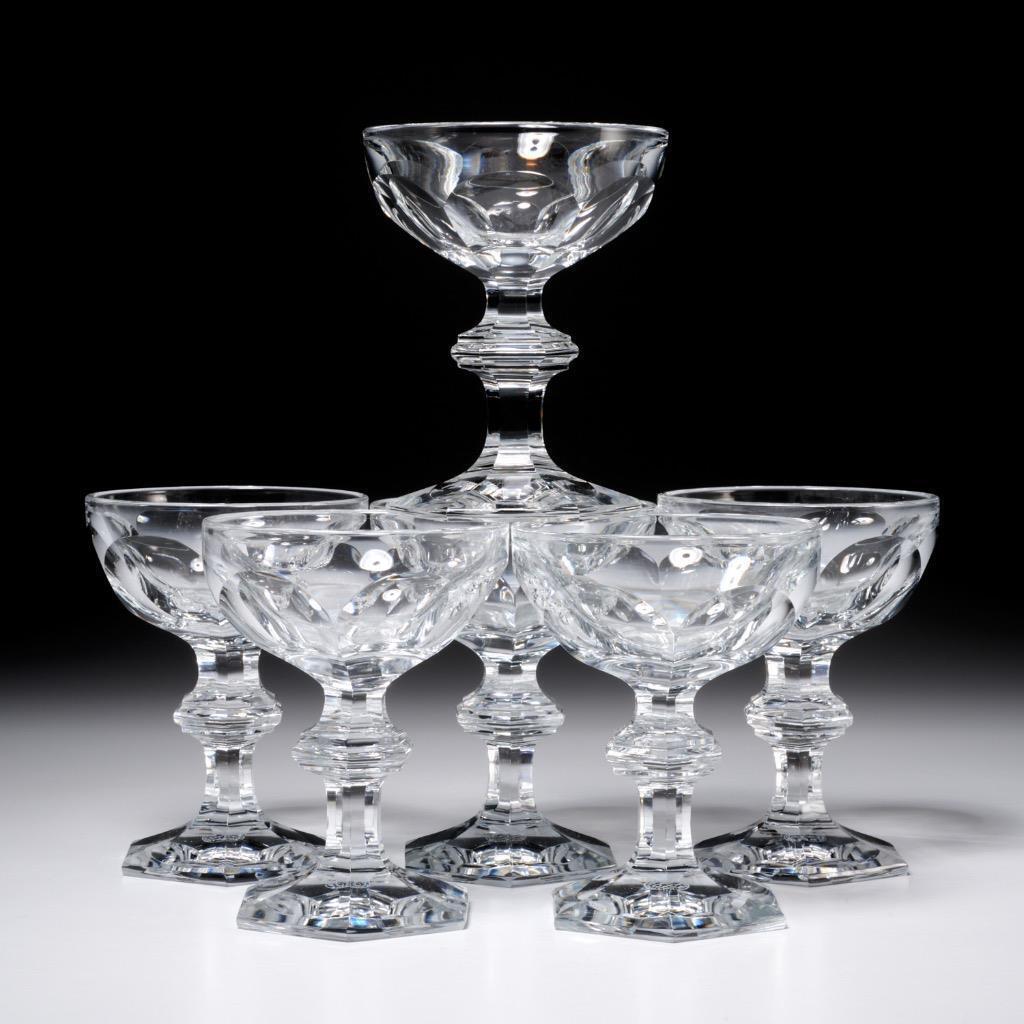
Sold on eBay January 9th, 2025
(6) Baccarat France Cut Crystal Harcourt 1841 Champagne Dessert Coupes Glasses B
Beautiful set of six (6) Baccarat France clear cut crystal champagne / dessert coupes in the Harcourt 1841 pattern. Good pre-owned condition, no chips or cracks observed. Measure is approx. 5"h x 4"w. Each marked with acid-etched Baccarat hallmark. Created in 1841, Harcourt 1841 stemware has been chosen by historical icons such as Pope John-Paul II, the Queen of Thailand and the King of Morocco. Characterized by an architectural silhouette, this graceful design brings storied elegance to the table. Beautiful set of six (6) Baccarat France clear cut crystal champagne / dessert coupes in the Harcourt 1841 pattern. Good pre-owned condition, no chips or cracks observed. Measure is approx. 5"h x 4"w. Each marked with acid-etched Baccarat hallmark. Created in 1841, Harcourt 1841 stemware has been chosen by historical icons such as Pope John-Paul II, the Queen of Thailand and the King of Morocco. Characterized by an architectural silhouette, this graceful design brings storied elegance to the table. Visit our store to see our complete selection of offerings from several categories including antiques, jewelry & handbags, sterling silver, porcelain, and more. We will combine shipping whenever possible. Also, add us to your favorites by clicking the "Sign up" button in the lower left-hand corner of our store page to receive the latest news from White Room Auctions, including special promotions and new offerings. All International shipments are declared for the full value. Customs and import taxes are paid by the recipient. Returns are accepted only if items are damaged in shipping or not as described. There may be a restocking fee for returns. Images sell!Get Supersized Images & Free Image Sellers - Get TemplatesImage Hosting, Scheduling at Auctiva.com. Track Page Views WithAuctiva's Counter (Condition: Pre-Owned)
Sold on eBay October 7th, 2023
BACCARAT "MILLE NUITS' AQUA AND CLEAR SET OF 3 GLASSES #394
BACCARAT "MILLE NUITS' AQUA AND CLEAR GLASS SET OF 3 Magnificent set of Baccarat MILLE NUIT champagne glasses in aqua and clear crystal. The base of the glass is heavily cut and sparkles as it goes up the stem to a large jewel that all parts are cut. The bowl is a beautiful shade of aqua and has an optic effect that catches the light. The entire glass on a table shimmers and very elegant. This is a must for those who entertain or possibly an upcoming wedding gift. Dimensions: HEIGHT: 11 1/2 inches Width: 3 history of Baccarat spans two hundred years, numerous wars, and unsurpassed advancement in crystal design and manufacturing. Baccarat is a small French town of 600 situated 250 miles east of Paris. In 1764, slightly prior to the French Revolution, Monseigneur de Montmorency Laval the Bishop of Metz, petitioned King Louis XV to allow him to open a glassworks factory on the banks of the River Meurthe. The reason for the Bishop’s interest in opening a glassworks factory was that he owned thousands of acres of old growth forests. In order to turn a profit on the deforestation of his land, the Bishop needed to find some industry that would consume lots of firewood. In 1765, the Compagnie des Cristalleries de Baccarat was established. The Bishop employed the influence of the church to locate an investor to build the factory. His next move was to find an architect and technician to run the factory. A man named Antoine Renaut was hired to oversee the building and running of the Baccarat factory. Baccarat flourished in the coming decades. By the beginnings of the French Revolution, the company employed a workforce of 400 people. It must be noted that Baccarat was opened during the age of reason and enlightenment. The managers at Baccarat decided to employee many of the social concepts concerning individual rights and human dignity that arose from the new social philosophies of the period. A small utopian community was built at the Baccarat factory that housed over 70 families. Although Baccarat was ahead of their time in concerning themselves with the welfare of their employees, their motives were not entirely altruistic. The firing of glass at the time was still an imperfect art and was influenced by many factors, including the weather. It was important to have Baccarat’s master craftsmen very close to the factory in order to produce the best possible product. During this time, the company mainly produced bottles, mirrors, and windows panes. Baccarat met a formidable challenge at the beginning of the French Revolution. Economic instability was common in France at this time, however, the situation worsened as the country collapsed into civil war. France’s economic situation continued to worsen with the Napoleonic wars that swept across Europe during the early 19th century. By 1816, inflation caused the company to operate at a loss and the workforce was reduced to less than 70 people. During that same year, the factory was sold to a Belgian expert in the production of glass. The purchaser, Monsieur d’Artigues bought the company with 2,845 ounces of solid gold. Monsieur d’Artigues was an ambitious man who set his sites on making Baccarat one of the most prestigious names in glass in Europe and the world. In 1838, a manager at Baccarat discovered a way to produce a full-lead crystal that could be colored. The formula was one of the company’s most closely guarded trade secrets. However, the information was leaked to the Bohemians living in the area who produced similar works to those of Baccarat. There was no competition between Baccarat and the Bohemians, however, as the Bohemian interest was purely artistic and they philosophically were not interested in making a profit. The factory continued to grow in prestige throughout the remainder of the 19th century. By the end of the 19th century, Baccarat had earned the reputation of being the “Crystal of Kings.” This title is one that the company bears to this day. Baccarat’s stemware and objects d’art adorned the tables of the late Czar and Czarina of Russia, the Emperor of Japan, the late Sultan of Turkey, the King of Siam, Presidents Theodore Roosevelt and Franklin Delano Roosevelt, the last three kings of France – Louis XVIII, Charles X, and Louis Philippe, all the Presidents of the French Republic, the Late Aga Kahn, Pope Benedict XV, President of the Republic of Chile, the former king of Portugal, the late king of Spain, the King of Greece, Emperor Haile Selassie of Ethiopia, the late Wilhelm II of Germany, the US State Departments’ many legations and European Embassies, all of the Maharajahs of India, and King Ibn of Saudia Arabia. For display pieces for the famous Paris Exhibition of 1889 (the same exhibition during which the Eiffel Tower was built), Baccarat created two of its most popular pattern Harcourt and Gascogne. Today, Harcourt is one of the Pope’s stemware patterns at the Vatican. (Condition: Pre-Owned)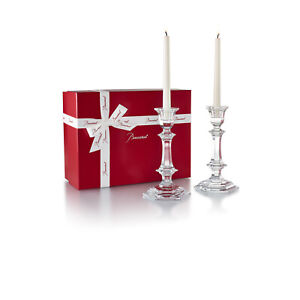
Sold on eBay November 5th, 2023
NEW BACCARAT CRYSTAL HAROCOURT CANDLESTICK PAIR #2813863 BRAND NIB SAVE$$ F/SH
eBay BRAND NEW BACCARAT #2813863 HARCOURT CANDLESTICK PAIR A real Baccarat icon, the Harcourt candle holder adapts to all styles with its powerful lines and its architectural style, classic and modern at the same time.A true Baccarat icon, and fruit of an unrivaled expertise, the Harcourt collection has traveled all around the world, proudly sporting its sculptural lines, instantly recognized by all. Created in 1841, the Harcourt collection has been chosen by historical icons Pope John-Paul II, the Queen of Thailand, the King of Morocco, and many other important figures. The Harcourt 1841 collection has also been a staple of French power, selected since the age of Napoleon III to its contemporary use in the Palais de l’Elysée Dimensions: 8.7" Height x 4.9" DiameterDon't miss the opportunity to purchase this elegant Baccarat candlestick! Harcourt Candle Stick Pair is BRAND NEW IN ORIGINAL BACCARAT BOX ON SALE NOW FOR BARGAIN PRICE $649.99!!! FREE SHIPPING within USA. Please feel free to contact us with any questions you may have. (Condition: Brand New)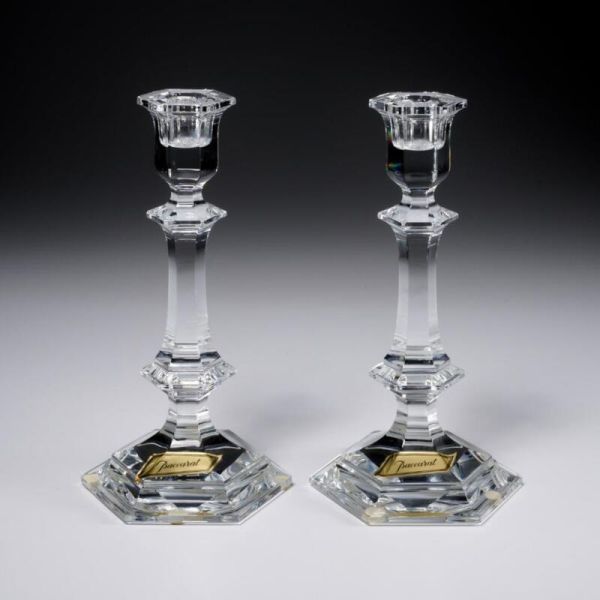
Sold on eBay October 14th, 2024
Pair Baccarat France Cut Crystal Harcourt 1841 Candlesticks 9in Baccarat Label
Beautiful pair of Baccarat France clear cut crystal candlesticks in the Harcourt 1841 pattern. Good pre-owned condition, no chips or cracks observed. Measure is approx. 9"h x 4.75"w. Each marked with acid-etched Baccarat hallmark and gold foil Baccarat label. Created in 1841, Harcourt 1841 stemware has been chosen by historical icons such as Pope John-Paul II, the Queen of Thailand and the King of Morocco. Characterized by an architectural silhouette, this graceful design brings storied elegance to the table. Beautiful pair of Baccarat France clear cut crystal candlesticks in the Harcourt 1841 pattern. Good pre-owned condition, no chips or cracks observed. Measure is approx. 9"h x 4.75"w. Each marked with acid-etched Baccarat hallmark and gold foil Baccarat label. Created in 1841, Harcourt 1841 stemware has been chosen by historical icons such as Pope John-Paul II, the Queen of Thailand and the King of Morocco. Characterized by an architectural silhouette, this graceful design brings storied elegance to the table. Visit our store to see our complete selection of offerings from several categories including antiques, jewelry & handbags, sterling silver, porcelain, and more. We will combine shipping whenever possible. Also, add us to your favorites by clicking the "Sign up" button in the lower left-hand corner of our store page to receive the latest news from White Room Auctions, including special promotions and new offerings. All International shipments are declared for the full value. Customs and import taxes are paid by the recipient. Returns are accepted only if items are damaged in shipping or not as described. There may be a restocking fee for returns. Pictures sell!Auctiva offers Free Image Hosting and Editing.The complete eBay Selling Solution. Track Page Views WithAuctiva's Counter (Condition: Pre-Owned)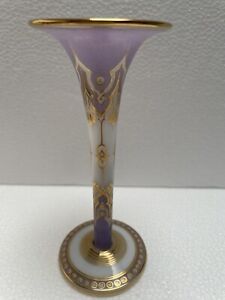
Sold on eBay July 28th, 2023
MAGNIFICENT BACCARAT OPALINE SOLIFLORE VASE #363
MAGNIFICENT BACCARAT OPALINE SOLIFLORE VASE Mint condition Antique ornate Baccarat vase with an Art Nouveau design. Beautifully hand painted with all the flare of the art nouveau period. Its main background is a pale lavender the detail and gracefulness of the painting and all embellished with gold details. This piece demonstrates the excellent workmanship only associated with the top French crystalleries. This would make a great gift or something to add to a collectors display or in a display cabinet Dimensions: DIAMETER: 2 1/2 INCHES / HEIGHT: 6 INCHESBACCARATThis history of Baccarat spans two hundred years, numerous wars, and unsurpassed advancement in crystal design and manufacturing. Baccarat is a small French town of 600 situated 250 miles east of Paris. In 1764, slightly prior to the French Revolution, Monseigneur de Montmorency Laval the Bishop of Metz, petitioned King Louis XV to allow him to open a glassworks factory on the banks of the River Meurthe. The reason for the Bishop’s interest in opening a glassworks factory was that he owned thousands of acres of old growth forests. In order to turn a profit on the deforestation of his land, the Bishop needed to find some industry that would consume lots of firewood. In 1765, the Compagnie des Cristalleries de Baccarat was established. The Bishop employed the influence of the church to locate investor to build the factory. His next move was to find an architect and technician to run the factory. A man named Antoine Renaut was hired to oversee the building and running of the Baccarat factory. Baccarat flourished in the coming decades. By the beginnings of the French Revolution, the company employed a work force of 400 people. It must be noted that Baccarat was opened during the age of reason and enlightenment. The managers at Baccarat decided to employee many of the social concepts concerning individual rights and human dignity that arose from the new social philosophies of the period. A small utopian community was built at the Baccarat factory that housed over 70 families. Although Baccarat was ahead of their time in concerning themselves with the welfare of their employees, their motives were not entirely altruistic. The firing of glass at the time was still an imperfect art and was influenced by many factors, including the weather. It was important to have Baccarat’s master craftsmen very close to the factory in order to produce the best possible product. During this time, the company mainly produced bottles, mirrors, and windows panes. Baccarat met a formidable challenge at the beginning of the French Revolution. Economic instability was common in France at this time, however, the situation worsened as the country collapsed into civil war. France’s economic situation continued to worsen with the Napoleonic wars that swept across Europe during the early 19th century. By 1816, inflation caused the company to operate at a loss and the work force was reduced to less than 70 people. During that same year, the factory was sold to a Belgian expert in the production of glass. The purchaser, Monsieur d’Artigues bought the company with 2,845 ounces of solid gold. Monsieur d’Artigues was an ambitious man who set his sites on making Baccarat one of the most prestigious names in glass in Europe and the world. In 1838, a manager at Baccarat discovered a way to produce full-lead crystal that could be colored. The formula was one of the company’s most closely guarded trade secrets. However, the information was leaked to the Bohemians living in the area who produced similar works to those of Baccarat. There was no competition between Baccarat and the Bohemians however, as the Bohemian interest was purely artistic and they philosophically were not interested in making a profit. The factory continued to grow in prestige throughout the remainder of the 19th century. By the end of the 19th century, Baccarat had earned the reputation of being the “Crystal of Kings.” This title is one that the company bears to this day. Baccarat’s stemware and objects d’art adorned the tables of the late Czar and Czarina of Russia, the Emperor of Japan, the late Sultan of Turkey, the King of Siam, Presidents Theodore Roosevelt and Franklin Delano Roosevelt, the last three kings of France – Louis XVIII, Charles X, and Louis Philippe, all the Presidents of the French Republic, the Late Aga Kahn, Pope Benedict XV, President of the Republic of Chile, the former king of Portugal, the late king of Spain, the King of Greece, Emperor Haile Selassie of Ethiopia, the late Wilhelm II of Germany, the US State Departments’ many legations and European Embassies, all of the Maharajahs of India, and King Ibn of Saudia Arabia. For display pieces for the famous Paris Exhibition of 1889 (the same exhibition during which the Eiffel Tower was built), Baccarat created two of its most popular pattern Harcourt and Gascogne. Today, Harcourt is one of the Pope’s stemware patterns at the Vatican. (Condition: Pre-Owned)
Sold on eBay August 25th, 2023
BACCARAT LARGE "CORAIL" SERVING BOWLS. CONTEMPORARY CRYSTAL #425
BACCARAT LARGE "CORAIL" SERVING BOWLS. CONTEMPORARY CRYSTALGREAT SIZE AND MULTI PURPOSE. CAN BE USED TO SERVE PART OF YOUR DINNER IN, CAN BE FOR A HOMEMADE DESSERT THIS SIZE IS IDEAL FOR 4-6 THERE ARE 3 BOWLS HOWEVER YOU ARE ONLY BE CHARGED FOR 2. ONE OF THE BOWLS HAS MANY SHELF SCRATCHES SO IT IS BEING OFFERED AS FREE. THERE ARE 3 LISTINGS FOR THESE BOWLS AND WOULD WORK VERY GOOD FOR SOMEONE WHO DOES ALOT OF ENTERTAINING WHEN THESE WERE OFFERED IN 1960 THE PRICE PRICE WAS 300 DOLLARS. THINK OF WHAT YOU MIGHT USE THESE FOR. HEIGHT: 3" WIDTH: 7 3/4" BACCARATThis history of Baccarat spans two hundred years, numerous wars, and unsurpassed advancement in crystal design and manufacturing. Baccarat is a small French town of 600 situated 250 miles east of Paris. In 1764, slightly prior to the French Revolution, Monseigneur de Montmorency Laval the Bishop of Metz, petitioned King Louis XV to allow him to open a glassworks factory on the banks of the River Meurthe. The reason for the Bishop’s interest in opening a glassworks factory was that he owned thousands of acres of old growth forests. In order to turn a profit on the deforestation of his land, the Bishop needed to find some industry that would consume lots of firewood. In 1765, the Compagnie des Cristalleries de Baccarat was established. The Bishop employed the influence of the church to locate an investor to build the factory. His next move was to find an architect and technician to run the factory. A man named Antoine Renaut was hired to oversee the building and running of the Baccarat factory. Baccarat flourished in the coming decades. By the beginnings of the French Revolution, the company employed a workforce of 400 people. It must be noted that Baccarat was opened during the age of reason and enlightenment. The managers at Baccarat decided to employee many of the social concepts concerning individual rights and human dignity that arose from the new social philosophies of the period. A small utopian community was built at the Baccarat factory that housed over 70 families. Although Baccarat was ahead of their time in concerning themselves with the welfare of their employees, their motives were not entirely altruistic. The firing of glass at the time was still an imperfect art and was influenced by many factors, including the weather. It was important to have Baccarat’s master craftsmen very close to the factory in order to produce the best possible product. During this time, the company mainly produced bottles, mirrors, and windows panes. Baccarat met a formidable challenge at the beginning of the French Revolution. Economic instability was common in France at this time, however, the situation worsened as the country collapsed into civil war. France’s economic situation continued to worsen with the Napoleonic wars that swept across Europe during the early 19th century. By 1816, inflation caused the company to operate at a loss and the workforce was reduced to less than 70 people. During that same year, the factory was sold to a Belgian expert in the production of glass. The purchaser, Monsieur d’Artigues bought the company with 2,845 ounces of solid gold. Monsieur d’Artigues was an ambitious man who set his sites on making Baccarat one of the most prestigious names in glass in Europe and the world. In 1838, a manager at Baccarat discovered a way to produce full-lead crystal that could be colored. The formula was one of the company’s most closely guarded trade secrets. However, the information was leaked to the Bohemians living in the area who produced similar works to those of Baccarat. There was no competition between Baccarat and the Bohemians, however, as the Bohemian interest was purely artistic and they philosophically were not interested in making a profit. The factory continued to grow in prestige throughout the remainder of the 19th century. By the end of the 19th century, Baccarat had earned the reputation of being the “Crystal of Kings.” This title is one that the company bears to this day. Baccarat’s stemware and objects d’art adorned the tables of the late Czar and Czarina of Russia, the Emperor of Japan, the late Sultan of Turkey, the King of Siam, Presidents Theodore Roosevelt and Franklin Delano Roosevelt, the last three kings of France – Louis XVIII, Charles X, and Louis Philippe, all the Presidents of the French Republic, the Late Aga Kahn, Pope Benedict XV, President of the Republic of Chile, the former king of Portugal, the late king of Spain, the King of Greece, Emperor Haile Selassie of Ethiopia, the late Wilhelm II of Germany, the US State Departments’ many legations and European Embassies, all of the Maharajahs of India, and King Ibn of Saudia Arabia. For display pieces for the famous Paris Exhibition of 1889 (the same exhibition during which the Eiffel Tower was built), Baccarat created two of its most popular pattern Harcourt and Gascogne. Today, Harcourt is one of the Pope’s stemware patterns at the Vatican. (Condition: Pre-Owned)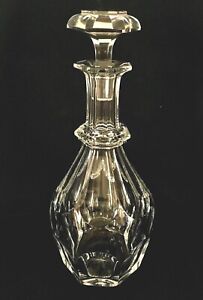
Sold on eBay April 5th, 2024
BACCARAT FRANCE 'HARCOURT' 1841 DECANTER, 11.9" Tall HANDCUT CRYSTAL & HANDMADE
Item under consideration is a beautiful, vintage, 11.9 inch tall, full lead crystal, Baccarat Harcourt 1841 CrystalDecanter Handcrafted decanter, mouth-blown and hand cut crystal, produced by Baccarat Crystal located in Baccarat, France Details:The Harcourt Crystal Cut is an Iconic Baccarat Design established in 1841, notable for it’s architectural form: a hexagonal base, triple knob stem, and flat cut sides. Beauty of the vessel is derived from its outline, heft, transparency, and bowl shape. Its regal and graceful form makes the Baccarat craftsmanship evident from every beveled angle.The Stopper is a diamond cut, beveled geometric shape. The baccarat mark is acid etched on the base. Decanter is still in production and retails new for $1435 without tax. the Harcourt Baccarat creation in 1841, the storied and elegant Harcourt 1841 stemware has been selected by Pope John-Paul II, the Queen of Thailand, the King of Morocco and many other important figures. This Clear Crystal Harcourt 1841 Decanter has an exquisite silhouette. Baccarat’s craftsmanship is apparent from every angle, as the architectural form creates extra visual depth. The classical shape has a requisite Harcourt 1841 hexagonal base and refined beveled cuts. The diamond-cut stopper crowns the decanter with sophistication Approximate Measurements: Stopper 11 7/8” (11 9”)Without Stopper 9 3/4”Diameter 5”Capacity: 25.4 ozStopper: Height 3 1/2”Diameter 3”Total Weight- 3 pounds, 11 ounces. (Condition: Pre-Owned)
Sold on eBay May 21st, 2024
MAGNIFICENT SET OF BACCARAT " HARCOURT GOLD " WINE SOLD INDIVIDUALLY #534
BACCARAT GLASSES "HARCOURT GOLD" 7 AVAILABLE COLORED CUT TO CLEAR SOLD INDIVIDUALLY #534 Magnificent set of Baccarat colored cut to clear Harcourt Gold wine goblets The intricate scallop cutting on the glasses side leaving a vignette to place the 24k filagree pattern the cup leads to a 6 sided stem and base the base highlighted like the glass top with a band of cold. This is not a common pattern especially in color and these are perfect. (2) Amethyst (1) Emerald (1) Cobalt (1) Lime (1) Orange (1) Fuschia I have never had them in this tall model in color in 50 years of french luxury goods. Dimensions: HEIGHT: 7 1/2 inches Width: 3" history of Baccarat spans two hundred years, numerous wars, and unsurpassed advancement in crystal design and manufacturing. Baccarat is a small French town of 600 situated 250 miles east of Paris. In 1764, slightly prior to the French Revolution, Monseigneur de Montmorency Laval the Bishop of Metz, petitioned King Louis XV to allow him to open a glassworks factory on the banks of the River Meurthe. The reason for the Bishop’s interest in opening a glassworks factory was that he owned thousands of acres of old growth forests. In order to turn a profit on the deforestation of his land, the Bishop needed to find some industry that would consume lots of firewood. In 1765, the Compagnie des Cristalleries de Baccarat was established. The Bishop employed the influence of the church to locate an investor to build the factory. His next move was to find an architect and technician to run the factory. A man named Antoine Renaut was hired to oversee the building and running of the Baccarat factory. Baccarat flourished in the coming decades. By the beginnings of the French Revolution, the company employed a workforce of 400 people. It must be noted that Baccarat was opened during the age of reason and enlightenment. The managers at Baccarat decided to employee many of the social concepts concerning individual rights and human dignity that arose from the new social philosophies of the period. A small utopian community was built at the Baccarat factory that housed over 70 families. Although Baccarat was ahead of their time in concerning themselves with the welfare of their employees, their motives were not entirely altruistic. The firing of glass at the time was still an imperfect art and was influenced by many factors, including the weather. It was important to have Baccarat’s master craftsmen very close to the factory in order to produce the best possible product. During this time, the company mainly produced bottles, mirrors, and windows panes. Baccarat met a formidable challenge at the beginning of the French Revolution. Economic instability was common in France at this time, however, the situation worsened as the country collapsed into civil war. France’s economic situation continued to worsen with the Napoleonic wars that swept across Europe during the early 19th century. By 1816, inflation caused the company to operate at a loss and the workforce was reduced to less than 70 people. During that same year, the factory was sold to a Belgian expert in the production of glass. The purchaser, Monsieur d’Artigues bought the company with 2,845 ounces of solid gold. Monsieur d’Artigues was an ambitious man who set his sites on making Baccarat one of the most prestigious names in glass in Europe and the world. In 1838, a manager at Baccarat discovered a way to produce a full-lead crystal that could be colored. The formula was one of the company’s most closely guarded trade secrets. However, the information was leaked to the Bohemians living in the area who produced similar works to those of Baccarat. There was no competition between Baccarat and the Bohemians, however, as the Bohemian interest was purely artistic and they philosophically were not interested in making a profit. The factory continued to grow in prestige throughout the remainder of the 19th century. By the end of the 19th century, Baccarat had earned the reputation of being the “Crystal of Kings.” This title is one that the company bears to this day. Baccarat’s stemware and objects d’art adorned the tables of the late Czar and Czarina of Russia, the Emperor of Japan, the late Sultan of Turkey, the King of Siam, Presidents Theodore Roosevelt and Franklin Delano Roosevelt, the last three kings of France – Louis XVIII, Charles X, and Louis Philippe, all the Presidents of the French Republic, the Late Aga Kahn, Pope Benedict XV, President of the Republic of Chile, the former king of Portugal, the late king of Spain, the King of Greece, Emperor Haile Selassie of Ethiopia, the late Wilhelm II of Germany, the US State Departments’ many legations and European Embassies, all of the Maharajahs of India, and King Ibn of Saudia Arabia. For display pieces for the famous Paris Exhibition of 1889 (the same exhibition during which the Eiffel Tower was built), Baccarat created two of its most popular pattern Harcourt and Gascogne. Today, Harcourt is one of the Pope’s stemware patterns at the Vatican. (Condition: Brand New)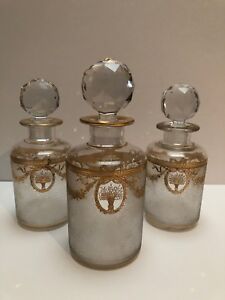
Sold on eBay January 15th, 2024
BACCARAT FROSTED PERFUME BOTTLES WITH ELABORATE GOLD GARLANDS AND FLOWERS
eBay BACCARAT MAGNIFICENT FROSTED PERFUME BOTTLES WITH GOLD GARLANDS AND FLOWERS SET OF 3Magnificent and in great condition. Antique large size perfume bottles with frosted backgrounds and gold garlands urns with flower bows and gold trim. These pieces execute many of the fine work Baccarat was famous for. The stoppers are very ornate cut crystal balls with a gold star on top. The pieces have miniscule gold loss. These pieces date from the 1900-1920's This is a beautiful and magnificent collection demonstrating the masterful work of Baccarat. Makes a great addition to a collectors collection or as a table piece or a focal piece in a vitrine. Dimensions: WIDTH : 3" INCH / HEIGHT: 7 1/2" INCH (2 bottles) WIDTH : 3 1/4" INCH / HEIGHT: 8 1/4" INCH (1 bottle) BACCARATThis history of Baccarat spans two hundred years, numerous wars, and unsurpassed advancement in crystal design and manufacturing. Baccarat is a small French town of 600 situated 250 miles east of Paris. In 1764, slightly prior to the French Revolution, Monseigneur de Montmorency Laval the Bishop of Metz, petitioned King Louis XV to allow him to open a glassworks factory on the banks of the River Meurthe. The reason for the Bishop’s interest in opening a glassworks factory was that he owned thousands of acres of old growth forests. In order to turn a profit on the deforestation of his land, the Bishop needed to find some industry that would consume lots of firewood. In 1765, the Compagnie des Cristalleries de Baccarat was established. The Bishop employed the influence of the church to locate an investor to build the factory. His next move was to find an architect and technician to run the factory. A man named Antoine Renaut was hired to oversee the building and running of the Baccarat factory. Baccarat flourished in the coming decades. By the beginnings of the French Revolution, the company employed a workforce of 400 people. It must be noted that Baccarat was opened during the age of reason and enlightenment. The managers at Baccarat decided to employee many of the social concepts concerning individual rights and human dignity that arose from the new social philosophies of the period. A small utopian community was built at the Baccarat factory that housed over 70 families. Although Baccarat was ahead of their time in concerning themselves with the welfare of their employees, their motives were not entirely altruistic. The firing of glass at the time was still an imperfect art and was influenced by many factors, including the weather. It was important to have Baccarat’s master craftsmen very close to the factory in order to produce the best possible product. During this time, the company mainly produced bottles, mirrors, and windows panes. Baccarat met a formidable challenge at the beginning of the French Revolution. Economic instability was common in France at this time, however, the situation worsened as the country collapsed into civil war. France’s economic situation continued to worsen with the Napoleonic wars that swept across Europe during the early 19th century. By 1816, inflation caused the company to operate at a loss and the workforce was reduced to less than 70 people. During that same year, the factory was sold to a Belgian expert in the production of glass. The purchaser, Monsieur d’Artigues bought the company with 2,845 ounces of solid gold. Monsieur d’Artigues was an ambitious man who set his sites on making Baccarat one of the most prestigious names in glass in Europe and the world. In 1838, a manager at Baccarat discovered a way to produce a full-lead crystal that could be colored. The formula was one of the company’s most closely guarded trade secrets. However, the information was leaked to the Bohemians living in the area who produced similar works to those of Baccarat. There was no competition between Baccarat and the Bohemians, however, as the Bohemian interest was purely artistic and they philosophically were not interested in making a profit. The factory continued to grow in prestige throughout the remainder of the 19th century. By the end of the 19th century, Baccarat had earned the reputation of being the “Crystal of Kings.” This title is one that the company bears to this day. Baccarat’s stemware and objects d’art adorned the tables of the late Czar and Czarina of Russia, the Emperor of Japan, the late Sultan of Turkey, the King of Siam, Presidents Theodore Roosevelt and Franklin Delano Roosevelt, the last three kings of France – Louis XVIII, Charles X, and Louis Philippe, all the Presidents of the French Republic, the Late Aga Kahn, Pope Benedict XV, President of the Republic of Chile, the former king of Portugal, the late king of Spain, the King of Greece, Emperor Haile Selassie of Ethiopia, the late Wilhelm II of Germany, the US State Departments’ many legations and European Embassies, all of the Maharajahs of India, and King Ibn of Saudia Arabia. For display pieces for the famous Paris Exhibition of 1889 (the same exhibition during which the Eiffel Tower was built), Baccarat created two of its most popular pattern Harcourt and Gascogne. Today, Harcourt is one of the Pope’s stemware patterns at the Vatican.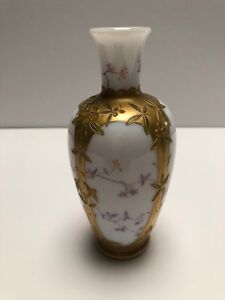
Sold on eBay July 28th, 2023
MAGNIFICENT BACCARAT OPALINE VASE HAND PAINTED WITH ORNATE GOLD WORK
BACCARAT ORNATE AND MAGNIFICENT WHITE OPALINE GOLD AND FLORAL VASEMagnificent and in mint condition. Antique ornate Baccarat vase divided into 4 panels that are surrounded by elaborate gold work with enamel flowers and leaves. The inset panels are painted with pastel branches of flowers following around the vase. The detail and gracefulness of the painting is beautiful and all embellished with gold details. No word can do justice to the work on this base All the gold branches and leaves are raised and the centers enameled in multi-color. This piece demonstrates the excellent workmanship only associated with the Baccarat crystallerie. This would make a great gift or something to add to a collectors display or a major focal point for a vitrine. Dimensions: DIAMETER: 2 3/4 INCHES / HEIGHT: 6 history of Baccarat spans two hundred years, numerous wars, and unsurpassed advancement in crystal design and manufacturing. Baccarat is a small French town of 600 situated 250 miles east of Paris. In 1764, slightly prior to the French Revolution, Monseigneur de Montmorency Laval the Bishop of Metz, petitioned King Louis XV to allow him to open a glassworks factory on the banks of the River Meurthe. The reason for the Bishop’s interest in opening a glassworks factory was that he owned thousands of acres of old growth forests. In order to turn a profit on the deforestation of his land, the Bishop needed to find some industry that would consume lots of firewood. In 1765, the Compagnie des Cristalleries de Baccarat was established. The Bishop employed the influence of the church to locate an investor to build the factory. His next move was to find an architect and technician to run the factory. A man named Antoine Renaut was hired to oversee the building and running of the Baccarat factory. Baccarat flourished in the coming decades. By the beginnings of the French Revolution, the company employed a workforce of 400 people. It must be noted that Baccarat was opened during the age of reason and enlightenment. The managers at Baccarat decided to employee many of the social concepts concerning individual rights and human dignity that arose from the new social philosophies of the period. A small utopian community was built at the Baccarat factory that housed over 70 families. Although Baccarat was ahead of their time in concerning themselves with the welfare of their employees, their motives were not entirely altruistic. The firing of glass at the time was still an imperfect art and was influenced by many factors, including the weather. It was important to have Baccarat’s master craftsmen very close to the factory in order to produce the best possible product. During this time, the company mainly produced bottles, mirrors, and windows panes. Baccarat met a formidable challenge at the beginning of the French Revolution. Economic instability was common in France at this time, however, the situation worsened as the country collapsed into civil war. France’s economic situation continued to worsen with the Napoleonic wars that swept across Europe during the early 19th century. By 1816, inflation caused the company to operate at a loss and the workforce was reduced to less than 70 people. During that same year, the factory was sold to a Belgian expert in the production of glass. The purchaser, Monsieur d’Artigues bought the company with 2,845 ounces of solid gold. Monsieur d’Artigues was an ambitious man who set his sites on making Baccarat one of the most prestigious names in glass in Europe and the world. In 1838, a manager at Baccarat discovered a way to produce a full-lead crystal that could be colored. The formula was one of the company’s most closely guarded trade secrets. However, the information was leaked to the Bohemians living in the area who produced similar works to those of Baccarat. There was no competition between Baccarat and the Bohemians, however, as the Bohemian interest was purely artistic and they philosophically were not interested in making a profit. The factory continued to grow in prestige throughout the remainder of the 19th century. By the end of the 19th century, Baccarat had earned the reputation of being the “Crystal of Kings.” This title is one that the company bears to this day. Baccarat’s stemware and objects d’art adorned the tables of the late Czar and Czarina of Russia, the Emperor of Japan, the late Sultan of Turkey, the King of Siam, Presidents Theodore Roosevelt and Franklin Delano Roosevelt, the last three kings of France – Louis XVIII, Charles X, and Louis Philippe, all the Presidents of the French Republic, the Late Aga Kahn, Pope Benedict XV, President of the Republic of Chile, the former king of Portugal, the late king of Spain, the King of Greece, Emperor Haile Selassie of Ethiopia, the late Wilhelm II of Germany, the US State Departments’ many legations and European Embassies, all of the Maharajahs of India, and King Ibn of Saudia Arabia. For display pieces for the famous Paris Exhibition of 1889 (the same exhibition during which the Eiffel Tower was built), Baccarat created two of its most popular pattern Harcourt and Gascogne. Today, Harcourt is one of the Pope’s stemware patterns at the Vatican.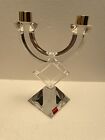
Sold on eBay June 13th, 2024
BACCARAT "SYMBOLE" CANDLESTICK FOR 2 CANDLES #372
RARE BACCARAT "SYMBOLE" CANDLE STICK FOR 2 CANDLESRarely seen the Symbole candlestick for 2 candles is magnificent. It starts on a clear crystal pyramid and then you find a clear see thru diamond shape ending with two curved arms bearing a diamond shape crystal piece with a dore gold bronze candle holder. This is contemporarqy and blends with all interiors I is in mint condition and never used. It is 8 1/4" high x 6" wide. wonderful gift no longer made"BACCARAT This history of Baccarat spans two hundred years, numerous wars, and unsurpassed advancement in crystal design and manufacturing. Baccarat is a small French town of 600 situated 250 miles east of Paris. In 1764, slightly prior to the French Revolution, Monseigneur de Montmorency Laval the Bishop of Metz, petitioned King Louis XV to allow him to open a glassworks factory on the banks of the River Meurthe. The reason for the Bishop’s interest in opening a glassworks factory was that he owned thousands of acres of old growth forests. In order to turn a profit on the deforestation of his land, the Bishop needed to find some industry that would consume lots of firewood. In 1765, the Compagnie des Cristalleries de Baccarat was established. The Bishop employed the influence of the church to locate an investor to build the factory. His next move was to find an architect and technician to run the factory. A man named Antoine Renaut was hired to oversee the building and running of the Baccarat factory. Baccarat flourished in the coming decades. By the beginnings of the French Revolution, the company employed a workforce of 400 people. It must be noted that Baccarat was opened during the age of reason and enlightenment. The managers at Baccarat decided to employee many of the social concepts concerning individual rights and human dignity that arose from the new social philosophies of the period. A small utopian community was built at the Baccarat factory that housed over 70 families. Although Baccarat was ahead of their time in concerning themselves with the welfare of their employees, their motives were not entirely altruistic. The firing of glass at the time was still an imperfect art and was influenced by many factors, including the weather. It was important to have Baccarat’s master craftsmen very close to the factory in order to produce the best possible product. During this time, the company mainly produced bottles, mirrors, and windows panes. Baccarat met a formidable challenge at the beginning of the French Revolution. Economic instability was common in France at this time, however, the situation worsened as the country collapsed into civil war. France’s economic situation continued to worsen with the Napoleonic wars that swept across Europe during the early 19th century. By 1816, inflation caused the company to operate at a loss and the workforce was reduced to less than 70 people. During that same year, the factory was sold to a Belgian expert in the production of glass. The purchaser, Monsieur d’Artigues bought the company with 2,845 ounces of solid gold. Monsieur d’Artigues was an ambitious man who set his sites on making Baccarat one of the most prestigious names in glass in Europe and the world. In 1838, a manager at Baccarat discovered a way to produce a full-lead crystal that could be colored. The formula was one of the company’s most closely guarded trade secrets. However, the information was leaked to the Bohemians living in the area who produced similar works to those of Baccarat. There was no competition between Baccarat and the Bohemians, however, as the Bohemian interest was purely artistic and they philosophically were not interested in making a profit. The factory continued to grow in prestige throughout the remainder of the 19th century. By the end of the 19th century, Baccarat had earned the reputation of being the “Crystal of Kings.” This title is one that the company bears to this day. Baccarat’s stemware and objects d’art adorned the tables of the late Czar and Czarina of Russia, the Emperor of Japan, the late Sultan of Turkey, the King of Siam, Presidents Theodore Roosevelt and Franklin Delano Roosevelt, the last three kings of France – Louis XVIII, Charles X, and Louis Philippe, all the Presidents of the French Republic, the Late Aga Kahn, Pope Benedict XV, President of the Republic of Chile, the former king of Portugal, the late king of Spain, the King of Greece, Emperor Haile Selassie of Ethiopia, the late Wilhelm II of Germany, the US State Departments’ many legations and European Embassies, all of the Maharajahs of India, and King Ibn of Saudia Arabia. For display pieces for the famous Paris Exhibition of 1889 (the same exhibition during which the Eiffel Tower was built), Baccarat created two of its most popular pattern Harcourt and Gascogne. Today, Harcourt is one of the Pope’s stemware patterns at the Vatican. (Condition: Pre-Owned)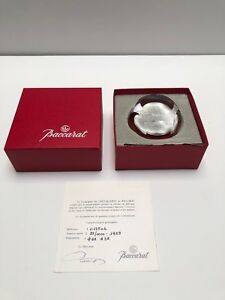
Sold on eBay November 7th, 2023
BACCARAT LIMITED EDITION PRESSE PAPIER #28/1000 CRYSTAL
eBay BACCARAT LIMITED EDITION PRESSE PAPIER #28/1000 BACCARAT presse papier depicting the FETE DE LA FEDERATION AU CHAMP DE MARS LE 14 JUILLET 1790 as conserved in the MUSEE CARNAVALET It is numbered #28/1000 and was made in 1989 and comes with the certificate of authenticity and the original box and history brochure. The detail is amazing and the depth of the scene magnificent. A very important piece to the paper weight collector or for someone who wants a piece of history on their desk. Size: 2 1/2" wide x 1 1/2" history of Baccarat spans two hundred years, numerous wars, and unsurpassed advancement in crystal design and manufacturing. Baccarat is a small French town of 600 situated 250 miles east of Paris. In 1764, slightly prior to the French Revolution, Monseigneur de Montmorency Laval the Bishop of Metz, petitioned King Louis XV to allow him to open a glassworks factory on the banks of the River Meurthe. The reason for the Bishop’s interest in opening a glassworks factory was that he owned thousands of acres of old growth forests. In order to turn a profit on the deforestation of his land, the Bishop needed to find some industry that would consume lots of firewood. In 1765, the Compagnie des Cristalleries de Baccarat was established. The Bishop employed the influence of the church to locate an investor to build the factory. His next move was to find an architect and technician to run the factory. A man named Antoine Renaut was hired to oversee the building and running of the Baccarat factory. Baccarat flourished in the coming decades. By the beginnings of the French Revolution, the company employed a workforce of 400 people. It must be noted that Baccarat was opened during the age of reason and enlightenment. The managers at Baccarat decided to employee many of the social concepts concerning individual rights and human dignity that arose from the new social philosophies of the period. A small utopian community was built at the Baccarat factory that housed over 70 families. Although Baccarat was ahead of their time in concerning themselves with the welfare of their employees, their motives were not entirely altruistic. The firing of glass at the time was still an imperfect art and was influenced by many factors, including the weather. It was important to have Baccarat’s master craftsmen very close to the factory in order to produce the best possible product. During this time, the company mainly produced bottles, mirrors, and windows panes. Baccarat met a formidable challenge at the beginning of the French Revolution. Economic instability was common in France at this time, however, the situation worsened as the country collapsed into civil war. France’s economic situation continued to worsen with the Napoleonic wars that swept across Europe during the early 19th century. By 1816, inflation caused the company to operate at a loss and the workforce was reduced to less than 70 people. During that same year, the factory was sold to a Belgian expert in the production of glass. The purchaser, Monsieur d’Artigues bought the company with 2,845 ounces of solid gold. Monsieur d’Artigues was an ambitious man who set his sites on making Baccarat one of the most prestigious names in glass in Europe and the world. In 1838, a manager at Baccarat discovered a way to produce a full-lead crystal that could be colored. The formula was one of the company’s most closely guarded trade secrets. However, the information was leaked to the Bohemians living in the area who produced similar works to those of Baccarat. There was no competition between Baccarat and the Bohemians, however, as the Bohemian interest was purely artistic and they philosophically were not interested in making a profit. The factory continued to grow in prestige throughout the remainder of the 19th century. By the end of the 19th century, Baccarat had earned the reputation of being the “Crystal of Kings.” This title is one that the company bears to this day. Baccarat’s stemware and objects d’art adorned the tables of the late Czar and Czarina of Russia, the Emperor of Japan, the late Sultan of Turkey, the King of Siam, Presidents Theodore Roosevelt and Franklin Delano Roosevelt, the last three kings of France – Louis XVIII, Charles X, and Louis Philippe, all the Presidents of the French Republic, the Late Aga Kahn, Pope Benedict XV, President of the Republic of Chile, the former king of Portugal, the late king of Spain, the King of Greece, Emperor Haile Selassie of Ethiopia, the late Wilhelm II of Germany, the US State Departments’ many legations and European Embassies, all of the Maharajahs of India, and King Ibn of Saudia Arabia. For display pieces for the famous Paris Exhibition of 1889 (the same exhibition during which the Eiffel Tower was built), Baccarat created two of its most popular pattern Harcourt and Gascogne. Today, Harcourt is one of the Pope’s stemware patterns at the Vatican.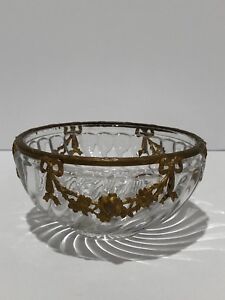
Sold on eBay October 24th, 2023
BACCARAT ANTIQUE BAMBOO PATTERN BOWL WITH GOLD ORMOLU ORNATE DETAIL
eBay BACCARAT ANTIQUE BAMBOO PATTERN BOWL WITH GOLD ORMULU ORNATE and in mint condition. Antique molded a crystal bowl in the bamboo pattern and large swirl molded star on base. Very heavy and with excellent workmanship associated with the top French crystalleries. This is a beautiful and magnificent piece demonstrating the master and articulate work of Baccarat. The ormolu is in pristine condition and the detail of the garlands is beautiful the Makes a great addition to a collectors collection or as a hostess gift or small centerpiece or a focal piece for a vitrine. Dimensions: DIAMETER: 5 INCH / HEIGHT : 2 3/4 history of Baccarat spans two hundred years, numerous wars, and unsurpassed advancement in crystal design and manufacturing. Baccarat is a small French town of 600 situated 250 miles east of Paris. In 1764, slightly prior to the French Revolution, Monseigneur de Montmorency Laval the Bishop of Metz, petitioned King Louis XV to allow him to open a glassworks factory on the banks of the River Meurthe. The reason for the Bishop’s interest in opening a glassworks factory was that he owned thousands of acres of old growth forests. In order to turn a profit on the deforestation of his land, the Bishop needed to find some industry that would consume lots of firewood. In 1765, the Compagnie des Cristalleries de Baccarat was established. The Bishop employed the influence of the church to locate an investor to build the factory. His next move was to find an architect and technician to run the factory. A man named Antoine Renaut was hired to oversee the building and running of the Baccarat factory. Baccarat flourished in the coming decades. By the beginnings of the French Revolution, the company employed a work force of 400 people. It must be noted that Baccarat was opened during the age of reason and enlightenment. The managers at Baccarat decided to employee many of the social concepts concerning individual rights and human dignity that arose from the new social philosophies of the period. A small utopian community was built at the Baccarat factory that housed over 70 families. Although Baccarat was ahead of their time in concerning themselves with the welfare of their employees, their motives were not entirely altruistic. The firing of glass at the time was still an imperfect art and was influenced by many factors, including the weather. It was important to have Baccarat’s master craftsmen very close to the factory in order to produce the best possible product. During this time, the company mainly produced bottles, mirrors, and windows panes. Baccarat met a formidable challenge at the beginning of the French Revolution. Economic instability was common in France at this time, however, the situation worsened as the country collapsed into civil war. France’s economic situation continued to worsen with the Napoleonic wars that swept across Europe during the early 19th century. By 1816, inflation caused the company to operate at a loss and the work force was reduced to less than 70 people. During that same year, the factory was sold to a Belgian expert in the production of glass. The purchaser, Monsieur d’Artigues bought the company with 2,845 ounces of solid gold. Monsieur d’Artigues was an ambitious man who set his sites on making Baccarat one of the most prestigious names in glass in Europe and the world. In 1838, a manager at Baccarat discovered a way to produce full-lead crystal that could be colored. The formula was one of the company’s most closely guarded trade secrets. However, the information was leaked to the Bohemians living in the area who produced similar works to those of Baccarat. There was no competition between Baccarat and the Bohemians however, as the Bohemian interest was purely artistic and they philosophically were not interested in making a profit. The factory continued to grow in prestige throughout the remainder of the 19th century. By the end of the 19th century, Baccarat had earned the reputation of being the “Crystal of Kings.” This title is one that the company bears to this day. Baccarat’s stemware and objects d’art adorned the tables of the late Czar and Czarina of Russia, the Emperor of Japan, the late Sultan of Turkey, the King of Siam, Presidents Theodore Roosevelt and Franklin Delano Roosevelt, the last three kings of France – Louis XVIII, Charles X, and Louis Philippe, all the Presidents of the French Republic, the Late Aga Kahn, Pope Benedict XV, President of the Republic of Chile, the former king of Portugal, the late king of Spain, the King of Greece, Emperor Haile Selassie of Ethiopia, the late Wilhelm II of Germany, the US State Departments’ many legations and European Embassies, all of the Maharajahs of India, and King Ibn of Saudia Arabia. For display pieces for the famous Paris Exhibition of 1889 (the same exhibition during which the Eiffel Tower was built), Baccarat created two of its most popular pattern Harcourt and Gascogne. Today, Harcourt is one of the Pope’s stemware patterns at the Vatican. (Condition: Pre-Owned)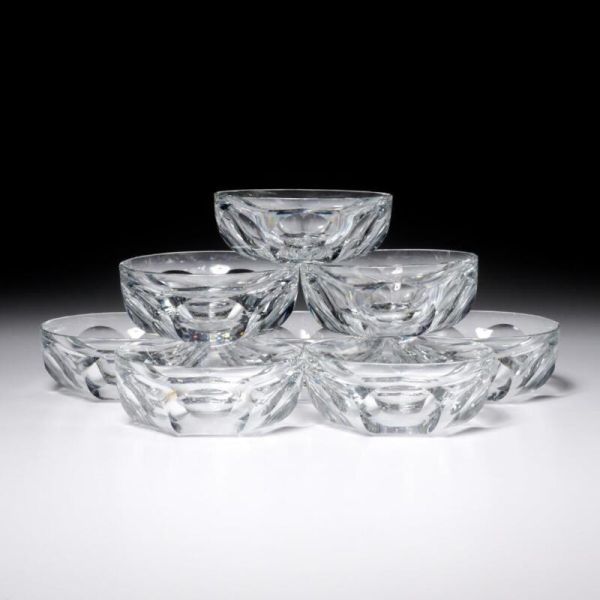
Sold on eBay October 18th, 2024
(8) Baccarat France Cut Crystal Harcourt 1841 Finger Bowls
Beautiful set of eight (8) Baccarat France clear cut crystal finger bowls in the Harcourt 1841 pattern. Good pre-owned condition, no chips or cracks observed. Measure is approx. 1.75"h x 4.5"w. Each marked with acid-etched Baccarat hallmark. Created in 1841, Harcourt 1841 stemware has been chosen by historical icons such as Pope John-Paul II, the Queen of Thailand and the King of Morocco. Characterized by an architectural silhouette, this graceful design brings storied elegance to the table. Beautiful set of eight (8) Baccarat France clear cut crystal finger bowls in the Harcourt 1841 pattern. Good pre-owned condition, no chips or cracks observed. Measure is approx. 1.75"h x 4.5"w. Each marked with acid-etched Baccarat hallmark. Created in 1841, Harcourt 1841 stemware has been chosen by historical icons such as Pope John-Paul II, the Queen of Thailand and the King of Morocco. Characterized by an architectural silhouette, this graceful design brings storied elegance to the table. Visit our store to see our complete selection of offerings from several categories including antiques, jewelry & handbags, sterling silver, porcelain, and more. We will combine shipping whenever possible. Also, add us to your favorites by clicking the "Sign up" button in the lower left-hand corner of our store page to receive the latest news from White Room Auctions, including special promotions and new offerings. All International shipments are declared for the full value. Customs and import taxes are paid by the recipient. Returns are accepted only if items are damaged in shipping or not as described. There may be a restocking fee for returns. Pictures sell!Auctiva offers Free Image Hosting and Editing.The complete eBay Selling Solution. Track Page Views WithAuctiva's Counter (Condition: Pre-Owned)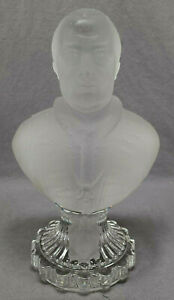
Sold on eBay August 29th, 2023
19th Century Baccarat Pope Pius IX Frosted Clear Pressed Glass Bust Antique
eBay 19th Century Baccarat Pope Pius IX Frosted Clear Pressed Glass Bust AntiqueNice 19th century Baccarat frosted clear pressed glass bust of Pope Pius IX. Unsigned. Would have originally had a sticker on the base. Has some scratches and a few small dings to the face, a flake to the back shoulder, and a few chips around the base, but otherwise good condition. Measures approximately 6 1/8 inches wide x 10 inches tall. This is an antique and may have small in manufacture defects that do not affect the display of the piece.EV(LB) (Condition: Pre-Owned)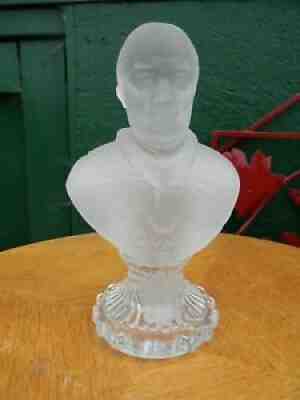
Sold on eBay Nov 22, 2021
Bust of pope pius ix crystal baccarat xix-th century
Cristal Baccarat. Buste du Pape Pie IX. Hauteur 25 cm.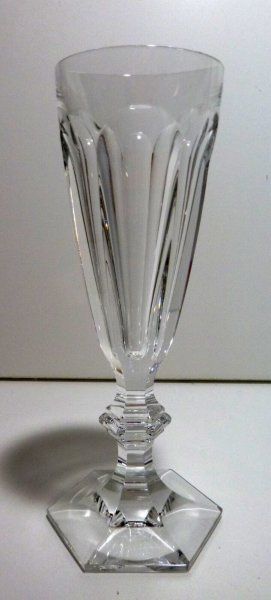
Sold on eBay November 4th, 2024